
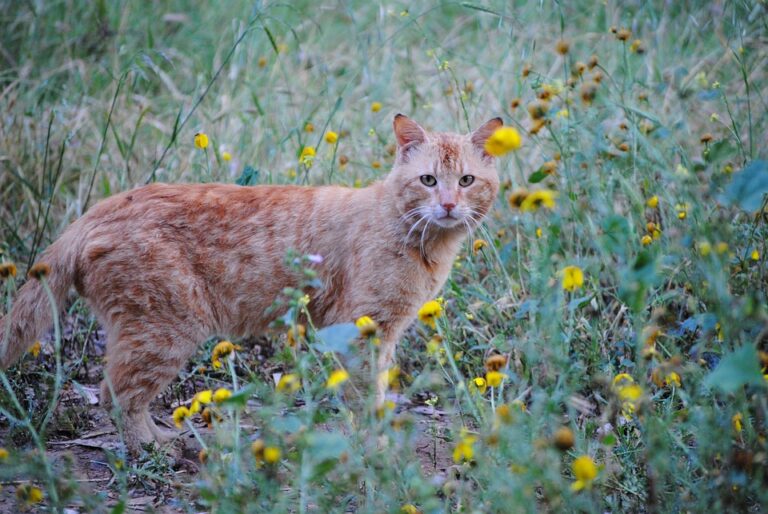
10 things you didn’t know about ginger cats

0

No matter what breed or type of cat they are, ginger cats are unique and loveable cats! We love them for their gorgeous coats, their personalities, and for the particularities of their coat!

In this article, we list 10 things you probably didn’t know ginger cats!

1. Ginger cats are usually male cats

You may not have known it, but in some cases, a cat’s coat is related to its gender. For instance, 80% of ginger cats are male. There are very few female cats with a red coat because of the sex chromosomes that they have. It is the “O” pigment gene which gives cats a red color. This gene connects to the X chromosome. Male cats, who have XY chromosomes, only need to inherit one “O” pigment gene in order to be a ginger cat. Females, who have XX chromosomes needs to have the “O” gene binded to both of their X chromosomes in order to obtain a red coat. This is much more complicated and therefore less likely. This is why there are very few female ginger cats.

2. So many famous ginger cats!

We love seeing red cats on the big screen and in books! Ginger cats have inspired many authors, screenwriters, and directors. For example, the famous Garfield is a plump ginger cat who has made us laugh for so many years. There is also Puss in Boots from the film Shrek, who has a strong character and knows how to manipulate others with his adorable eyes! You have probably also noticed that in the Harry Potter series, Hermione’s cat, Crookshanks, is a ginger cat.

However, these cats aren’t just famous in movies! There are so many famous ginger cats on Instagram as well! For example, you can search up #gingercat on Instagram and you’ll find so many adorable cats!

3. 5 types of ginger coats

Not all ginger cats have the same pattern or markings. For example, cats can have a “mackerel”, “tabby”, or “striped” pattern.

If you are interested in learning more about coat patterns, you can take a look at this article: Cat coats: the different colors and markings

4. Ginger cats can have freckles

Just like humans, ginger cats can have freckles. However, unlike human freckles, cat freckles are black. They can be present all over the body but are generally more abundant on the nose. In addition, the amount of freckles that a red cat has usually multiplies as they get older.

5. Ginger cats have a strong personality

All red cat owners generally agree that their little ones have a strong character! However, just because they are known for having a lively and playful personality does not mean that ginger cats are not affectionate. These cats know how to show affection, while still keeping their rather independent and stubborn personality.

6. Cat breeds that allow ginger fur

For some breed standards, a ginger coat is an eliminatory criterion. For others though, a red or orange color is allowed by the standard. Some of these include the Maine CoonNorwegian Forest cat, Persian, American Bobtail, and British Shorthair breeds.

7. So many perfect names!

When owners choose a name for their cat, they are often inspired by the color of their cat’s coat. That’s why there are many cats with names like Butterscotch, Apricot, Tiger, Honey, and Pumpkin. All of these names refer to red coats that vary from beige to a more pronounced red color!

8. Pheomelanin

Did you know that their reddish orange color comes from a particular pigment? It’s called pheomelanin. This pigment is in the same family as melanin, which is also present in humans and other mammals. Everyone has more or less of it and it gives color to our skin and hair. However, the amount of the pigment determines the intensity of the red color. For example, a cat with a small amount of pheomelanin will have a beige toned coat while a cat with a lot of pheomelanin will have a more red colored coat.

9. Winston Churchill’s cat

Have you heard of Jock, Winston Churchill’s cat? This politician really loved cats! After Churchill lost his cat, Nelson, he decided to adopt Jock. Churchill and Jock were so close. In fact, he even nicknamed him “his private secretary”. Jock was even allowed to come to meetings during the war. It is also said that Winston Churchill refused to start his meal if his cat was not sitting near him!

10. Unique cats

As you can see from the nine things that we mentioned earlier, ginger cats are very unique! Even though all cats are unique in their own way, these fire-colored cats are exceptional when it comes to their color, their behavior, and their personality. They are great pets and get along well with everyone!

Ugandan Ivory Trader Gets a Life Sentence: Report

A court in Uganda has sentenced an ivory trader to life in prison, the longest sentence for such crimes in the country’s history.

In a historical ruling, Uganda’s Standards, Utilities and Wildlife Court sentenced a man to life in prison for illegal possession of two pieces of ivory on Thursday, the Uganda Wildlife Authority announced in a press statement.

Pascal Ochiba was arrested on January 18 in Kampala after being found in illegal possession of two pieces of ivory weighing slightly below 10 kilograms.

This was not the first time Ochiba got into conflict with the law.

In 2017, he was arrested for possession of four ivory pieces and an Okapi skin and subsequently sent to prison for 18 months.

Explaining her ruling, the judge said that as a habitual offender, Ochiba would pose a threat to Uganda’s endangered species if left free.

She added that offenses of unlawful possession of protected species were still rampant and there was a need to curb them down.

The sentence was made possible by Uganda’s 2019 Wildlife Act, which extended potential penalties for wildlife crime to life imprisonment.

Uganda’s elephant population, including both savannah and forest African elephants, was recorded at around 5,000 in 2016 – a marked increase from 700-800 elephants in the 1980s.

However, according to the Wildlife Conservation Society, Ugandan elephants are still exposed to significant poaching.

This comes in addition to the increasing encroachment of elephant migration routes by Uganda’s growing population, which fuels human-wildlife conflict.

Uganda, surrounded by countries with rich wildlife populations, has served as a prominent wildlife trafficking hotspot, with traffickers taking advantage of its so far weak law enforcement.

For example, a recently dismantled East African wildlife trafficking ring was reported to be headquartered in Uganda.

The Executive Director of the Uganda Wildlife Authority, Sam Mwandha, expressed optimism about the Court’s decision.

“This is a landmark achievement in our war on illegal wildlife trade in Uganda. We must do our best in our times to protect our wildlife otherwise history will judge us harshly,” he said.


Fish and Game officer picks up alligator in New Plymouth

A non-native alligator was discovered roaming loose in Idaho, the United States, and according to the wildlife authorities.

A non-native alligator was discovered roaming loose in Idaho, the United States, and according to the wildlife authorities, they are still looking into its history, said a report in UPI. An individual from the New Plymouth region called Idaho Fish and Game on Thursday night to report seeing a three-and-a-half foot alligator while strolling their dog, the agency said.

The alligator was captured by the homeowner and placed in a horse trailer, where it was later removed the following morning by Fish and Game Officer Brian Marek.

As quoted by The Fish and Game news release, regional conservation officer Matt O’Connell said that, “In all likelihood, this alligator got loose from someone, and we are interested in finding the owner.”

idfg.idaho.gov

“Fish and Game is investigating where the alligator may have come from, and anyone with information is asked to contact the Southwest Regional Office during normal business hours or the Citizens Against Poaching hotline,” the release further said.

Alligator (or any other crocodilian) possession without the appropriate permission is prohibited in Idaho, as is the discharge of captive crocodilians into the wild.

Pictures and videos of alligators and related incidents have been frequently shared on the internet. Recently, a video went viral on social media featuring a woman feeding an alligator while removing the cage’s glass doors.

The alligator, dubbed “Darth Gator,” tried to jump out of the glass cage to attack the zookeeper when she asked the alligators if they were hungry. The alligator made an attempt to eat the zookeeper’s arm.

The video was posted on Instagram by the page The Reptile Zoo with the caption, “Darth Gator wants to eat wow.”


Kerala temple’s famous ‘vegetarian’ crocodile dies

Babiya had lived at Sri Ananthapura Lake Temple since 1942, where it was considered the guardian

A famous “vegetarian” crocodile was buried with saintly honours on Monday after spending eight decades at a Hindu temple in the southern Indian state of Kerala.

Babiya, a three-metre-long mugger crodile (Crocodylus palustris) was considered the guardian of the 9th-century Sri Ananthapura Lake Temple in Kasaragod and was popular with devotees who came to pray there.

Ramachandra Bhat, secretary of the temple committee, said the crocodile had been unwell and was being treated by vets from Pilikula Biological Park in neighbouring Karnataka state.

“We found her body late at night, around 11pm. She was not keeping well for some time … we are heartbroken,” Mr Bhat told The National.

thenationalnews.com

More than 1,000 devotees attended the funeral as temple authorities buried Babiya with all the honours given to a saint on Monday afternoon.

The crocodile was a popular attraction at the temple, which is surrounded by a natural lake. Devotees often fed her “prasad” — an offering made of rice and jaggery that was first presented to the temple deity.

Many devotees claimed she ate only vegetarian food, but there is no evidence to back that. crocodiles often feed at night, and the temple lake contains plenty of fish, snakes and eels. Mr Bhat said Babiya appeared at the temple some time in 1942. She was allowed to roam freely and often basked in the sun on the temple stairs.

She was popular for her calm demeanour and had never scared or attacked anyone, he said. “She fed on vegetarian food, mostly coconut. She was the guard of the temple,” Mr Bhat said. “People would wait to catch a glimpse of her but only the lucky ones could see and feed her if she came to them of her own will,” he said.

Cheetah: World’s fastest cat returns to India after 70 years

Cheetahs are set to roam in India for the first time since they were declared officially extinct in 1952.

twitter.com/IndiainNamibia

A group of eight cats arrived from Namibia on the occasion of Prime Minister Narendra Modi’s birthday on Saturday.

They will undergo a month-long quarantine before being released in a national park in central India. Cheetahs formerly shared jungles with other big cats like lions and tigers but disappeared 70 years ago.

They are the world’s fastest land animals, capable of reaching speeds of 70 miles (113km) an hour. This is the first time a large carnivore is being moved from one continent to another and being reintroduced in the wild.

At least 20 cheetahs are coming to India from South Africa and Namibia, home to more than a third of the world’s 7,000 cheetahs. The first batch of eight – five females and three males, aged between two and six years – will arrive from Windhoek in Namibia to the Indian city of Gwalior on Saturday.

Inside India’s plan to bring back extinct cheetahs

WSON Team


Wildlife experts, veterinary doctors and three biologists will accompany the animals as they make the transcontinental journey in a modified passenger Boeing 747 plane.

From Gwalior, the cheetahs will be transferred by helicopter to Kuno National Park in Madhya Pradesh state, where they will be released by a delegation led by Mr Modi.

Spread over a 289-square-mile area, the Kuno National Park is a sprawling sanctuary with prey like antelope and wild boars for the wild cats.

An electrified enclosure, with 10 compartments ranging in size, has been built for the animals to quarantine before being released in the wild.

Each cheetah will be given a dedicated team of volunteers, which will monitor it and keep tabs on the animal’s movement. Satellite radio collars have been put on each cheetah for their geolocation updates.

WSON Team

India has been making efforts to reintroduce cheetahs since the 1950s. An effort in the 1970s from Iran was unsuccessful after the Shah of Iran was deposed and the negotiations stopped.

Proponents of the project say that the reintroduction of cheetahs will build up local economies and help restore ecosystems that support the big cats.

But some worry that relocation of animals is always fraught with risks and releasing the cheetahs into a park might put them in harm’s way.

Cheetahs are delicate animals who avoid conflict, and are targeted by competing predators. And the Kuno park has a sizeable leopard population which could kill cheetah cubs.

WSON Team

There is also a possibility that the cheetahs can stray outside the boundaries and get killed by people or other animals.

However, officials say the fears are unfounded as cheetahs are highly adaptable animals, and claim that the shortlisted site has been fully examined for habitat, prey and potential for man-animal conflict.

The first cheetah in the world to be bred in captivity was in India during the rule of Mughal emperor Jahangir.

His father, Akbar, recorded that there were 10,000 cheetahs during his time. He reigned from 1556 to 1605.

Much later, research suggested the number of cheetahs had dropped to a couple of hundred by the 19th Century – and the cat was reportedly sighted for the last time in India 70 years ago.