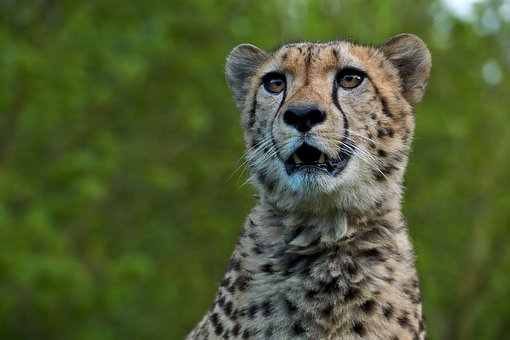
Prime Minister Narendra Modi, who is celebrating his birthday, will release three of the cheetahs in quarantine enclosures of the park
Social Media
Two helicopters carrying eight cheetahs reached Palpur near Kuno National Park in Madhya Pradesh on Saturday, following their arrival in Gwalior from Namibia in a special plane as part of the programme to reintroduce the feline in India seven decades after it was declared extinct in the country.
Social Media
A modified Boeing aircraft, which took off from the African country Friday night, carried the cheetahs in special wooden crates during the around 10-hour journey. The plane landed at the Gwalior airbase shortly before 8.00 a.m., an official said.
The animals were later taken to Palpur near the KNP in Sheopur district, 165 km from Gwalior, in two helicopters. Prime Minister Narendra Modi, who is celebrating his birthday, will release three of the cheetahs in quarantine enclosures of the park at 10.45 a.m.
To be released in an enclosure
Social Media
The cheetahs remained without food during the journey and will be given something to eat once they are released in the enclosures, an official said.
A dais has been set up in the Park under which special cages carrying cheetahs will be kept and Mr. Modi will release three of them in an enclosure by operating a lever. After that, other dignitaries will release the remaining cheetahs in other enclosures, he said.
Social Media
The cheetahs were brought in a special flight of Terra Avia, an airline based at Chisinau, Moldova in Europe that operates chartered passenger and cargo flights. The Park is situated on the northern side of Vidhyachal mountains and is spread across 344 sq km.
Officials battled heavy rain, inclement weather and some blocked roads to complete the preparations for Mr. Modi’s programme to release the big cats in their new home in Kuno. Two days before Mr. Modi’s arrival, heavy rain lashed the Gwalior-Chambal region of Madhya Pradesh.
The Border Collie that we know today originates from the mid-twentieth century. Back then, this dog appeared in many forms of literature.
However, the origin of the name “Collie” is still unclear. While some consider that it references the Gaelic word meaning “useful”, others think it is a reference to the German word “Kuli” meaning “worker”.
One thing is certain, the breed originated near the Anglo-Scottish border. This explains the word “Border” in Border Collie.
As the name suggests, the Border Collie is a working dog. This breed was born and bred to guard livestock on farms. However, the Border Collie was not the only sheepdog in the United Kingdom at that time. Many breeds that descended from a common ancestral gene pool were used as herding dogs.
All over the country, a sort of ideological war was waged between farmers to determine the best breed of a sheepdog. On October 9, 1873, during the first sheepdog trials in Bala, Wales, many dogs competed against each other for the first time. This contest was organized by Richard John Lloyd-Price. The first prize of this competition was awarded to James Thompson and his dog, a Border Collie. This title marked the beginning of the Border Collie’s reign as Britain’s best sheepdog.
The same year, a good friend of Richard John Lloyd-Price, Sewallis E. Shirley founded The Kennel Club UK.
The Border Collie’s personality
WSON Team
An energetic dog breed
The Border Collie is a determined, alert, and intelligent dog. They are neither aggressive nor nervous. They are known for their inexhaustible energy. Therefore, this dog breed needs an active family. They will not be happy with life in the city. As Border Collies need a lot of exercise, they tend to love country life as well as sports activities such as agility.
When outside, they are fearless. They are always ready to take on new challenges. When indoors, however, this breed loves to be cuddled and surrounded by his or her family.
What are the Border Collie’s needs?
The Border Collie is not a difficult dog. They just need a lot of exercise, playtime, and love.
If you cannot provide them with the lifestyle they need, they can quickly become unmanageable, destructive, and depressed. Their well-being should not be taken lightly.
The physical characteristics of the Border Collie
WSON Team
General
This dog breed is a medium-sized dog with a sturdy appearance. They have a solid, athletic, balanced, and graceful structure. They have a lively and alert look.
Head
This dog breed’s skull is quite large. The occiput is not pronounced. The muzzle tapers off at the end. The Border Collie is moderately short and strong. The skull and muzzle are approximately the same lengths. When it comes to the stop, it is well-marked.
Their nose should be black, with the exception of dogs with a chocolate coat, who may have a liver-colored nose. If the dog’s coat is blue, then the nose should be grayish. The nostrils are well developed.
Their jaws, as well as their teeth, are strong and they have a perfect scissor bite. Their cheeks are neither full nor rounded.
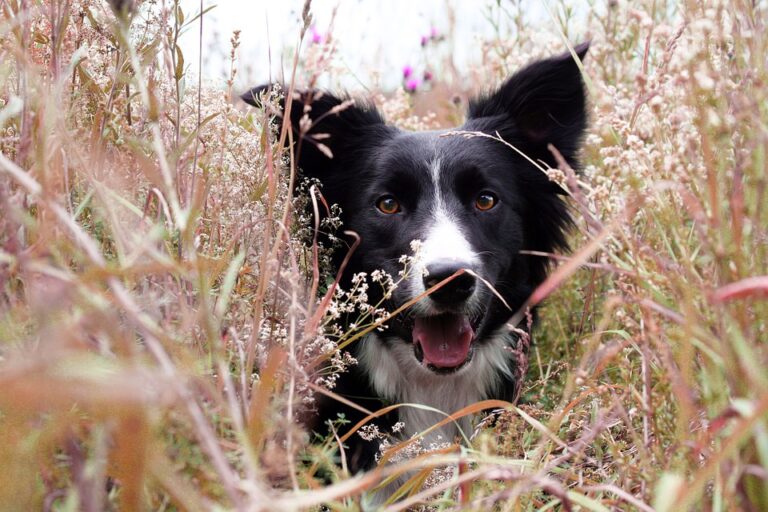
When it comes to their eyes, they are wide apart, medium, and oval. Border Collies can have green, brown, or blue eyes. Brown is the most common. Blue eyes are usually found in dogs with a merle pattern. Their expression is soft, lively, intelligent, and alert.
This dog’s ears are medium and texture. They have spread well apart on the skull, straight and attentive to the slightest noise.
Body
This dog breed’s back is straight and strong. It is horizontal and firm from the withers to the hips. The chest is quite broad, while its ribs are well-sprung.
The thighs are long, broad, and well-muscled. The hocks are strong and well let down. As for their feet, they are oval in shape with thick, strong, and healthy paw pads.
Their tail is moderately long. It is set low curves upward.
Coat, color, and care
WSON Team
Coat
The Border Collie can be short-haired or medium-long-haired. They also have a double coat, which helps them stay warm when temperatures are low.
Colors
According to the breed standard, all colors are allowed as long as white is not dominant.
One of the most common color combinations is white and black with a white line running from the top of the skull to the sides of the muzzle and a white ruff. The two front legs are often white as well. When it comes to the back legs, they can have white areas that look like socks. The tip of the tail can also be white.
Other types of coats may have tawny spots on the head and legs. This dog breed can also be merle red or merle blue. Some of the colors that can be found on the Border Collie are chocolate and white, sand and white, red and white, blue and white.
Caring for a Border Collie
Similar to most dog breeds, the Border Collie sheds twice a year, in the fall and spring. This is especially the case when they spend a lot of time outside. If your dog is indoors more often, he or she may lose hair throughout the year.
Border Collies should be brushed at least once a week to get rid of dead hair.
The Border Collie at a glance
WSON Team
Size: 50 to 56 cm at the withers.
Weight: 25 to 30 kg (around 55 to 66 lbs).
Average lifespan: 10-20 years.
Is this dog breed good with children? Well-trained Border Collies who are comfortable with their family are wonderful companions for children.
Is this dog breed easy to train? The Border Collie is one of the most intelligent dog breeds in the world. They have a strong willingness to learn and love to please their owners. In general, these dogs are easy to train and quickly understand what is expected of them.
“Jana Gana Mana Adhinayak Jay hai”– You are the ruler of the minds of the people,let the victory be with you.
Indian National Anthem is a solemn patriotic song that is an expression of national identity. We are immensely proud of our country as we have struggled a lot to get the freedom we are enjoying today. Our history of striving for freedom is inspiring for any country. This freedom has cost us many lives. However, the battle was not over even after getting the freedom. Our freedom fighters have protested for a better future for India, though several additional battles were loitering in the way for India.
delhinewswatch.com
The war was not over after getting freedom from British rule. We have had wars with Pakistan, China, Bangladesh, and other nations. The Indian army has always been a powerful one in the conflict. We have resolved and revolted for the sake of the freedom of India. Every Indian feels enormous pride while meeting, seeing, or talking with a soldier.
The Indian army is the fourth most powerful army in the world. Nevertheless, we don’t stop there. We have Central Reserve Police Force as India’s largest central armed police force which has seven central armed police organizations Border Security Force, Central Reserve Police Force, Central Industrial Security Force, Indo-Tibetan Border Police, Sashastra Seema Bal, National Security Guard, and Special Protection Group. The crucial purpose of these unions is the security of the nation.
gujarattourism.com
The Border Security Force was established in 1965 to protect India’s international borders. In the year of 1971, the Border Security Force played a pivotal role in Indo-Pak War in Banaskantha, Gujarat. BSF did not wait, they stepped in and took the charge till the time the Indian Army arrived. This act of bravery and passion for the nation was applauded.
This year, the government of India appreciated this action by making it a tourist place. The government developed a 125/- crore Seema Darshan Project At Nadabet, Gujarat.
The Seema Darshan Project is the first state-of-the-art BSF project in the country. The Seema Darshan Project is a joint initiative of the tourism department of the state government and the BSF Gujarat Frontier. This tourist spot will demonstrate the origin, development, and role of BSF in the wars. Union Home Minister Mr. Amit Shah integrated the Indo-Pak border viewing point in Nada Bet, Gujarat on Sunday, 10th April 2022. The Seema Darshan has been built on the lines of the Wagah-Atari border of Punjab. Seema Darshan offers travelers to witness the working of an army post on the border of India.
gujarattourism.com
The major attraction of Nada Bet is the access provided to civilians to see the fenced International border with Pakistan at zero point. Tourists will be able to see various weapons of the Indian Army and BSF such as surface to surface and surface to air missiles, T-55 tanks, artillery, guns, wing drop tanks, MiG-27 aircraft, and torpedoes on the spot. The biggest attraction would be a retreat parade ceremony where the BSF jawans put up a heroic show of marching with pride to end another day of guarding the borders.
The centerpiece of Seema Darshan is a 30 feet high T-Junction Pillar which is decorated with murals portraying the border protectors in action. Another sculpture named Ajay Prahari has been built in the memory of the heroic soldiers who sacrificed their lives while protecting the nation.
myahmedabad.blog
Other than these, there is a toy train ride, an art gallery on Naam Namak Nishan, a food court, a Souvenir/Handicraft shop, a kids’ play area, Museum on Sarhad Gatha, Photo opp AT MIG 27, an AV experience zone, 180° photo booth, BSF quiz, AR selfie booth, AR wall mural for tourists. Plus there are adventures like zipline and zip cycling, free-falling, giant swing, high and low rope course, human bungee slingshot, paintball, rappelling, rock climbing, and rocket ejector for adventure junkies.
gujarattourism.com
The Seema Darshan Project is a spot to live the untold story of Nada Bet. The story of the 1971 Indo-Pak war will give you chills. The thrill to fight a war and enthusiasm for protecting the nation will burst you into multiple emotions. The stories of soldiers’ unconditional love towards the nation and its security would inspire you to the core. Thus, this is not just a tourist spot, it’s an emotion!
The fastest land animal in the world declared extinct in the country in 1952, will find a new home in the Kuno-Palpur National Park (KNP) in the Sheopur district probably at a time when India will be celebrating its 75th Independence Day, a senior forest department official said.
A wildlife sanctuary in Madhya Pradesh is getting ready to welcome its new inhabitants, African cheetahs, which are being brought under an intercontinental translocation project and if everything goes as per plan, the majestic beasts will be here as early as next month.
The fastest land animal in the world declared extinct in the country in 1952, will find a new home in the Kuno-Palpur National Park (KNP) in the Sheopur district probably at a time when India will be celebrating its 75th Independence Day, a senior forest department official said.“We are working on it. Cheetahs will come to Madhya Pradesh in August,” the forest department’s principal secretary Ashok Barnwal told.
When specifically asked if the big cats, which can sprint at speeds of 80 to 130 km per hour, will arrive in the park on August 15, he said “It can happen.” Asked whether the world’s fastest mammals will be brought from Namibia or South Africa, Mr. Barnwal said, “Initially from South Africa.” On the status of memorandums of understanding (MoUs) with these two countries on translocation of cheetahs, the top forest official said they are yet to be finalized.
An MoU will be signed with South Africa soon, Mr. Barnwal said without elaborating further.
Cheetahs are mainly found in Africa.
Wildlife Institute of India (WII) dean and senior professor Yadvendradev Vikramsinh Jhala also did not give any exact date for the arrival of the fierce felines at KNP.
The Dehradun-based institute is also involved in the translocation project.
When pointed out that India was still to sign an MoU, either with Namibia or South Africa, for the cheetah reintroduction programme, Mr. Jhala said a lot of legalities are involved in such projects.
“It depends on the (Indian) government. It (MoU) can be done in two days or it may take two months. There are a lot of legalities involved in it,” the WII dean said.
Another forest department official said the number of cheetahs to be brought to India will be decided by the central government, but added preparations are on at KNP to receive and house them.
“Our preparations are going on in full swing to welcome cheetahs back to India but we don’t know anything about the actual date of arrival or the number of big cats coming to Madhya Pradesh as it is being finalized at the level of the Government of India,” principal chief conservator of forest (PCCF-Wildlife) J S Chauhan said.
He said KNP has made preparations for housing 12 to 15 cheetahs, including females, and has earmarked an area of five square kilometres having eight compartments in it for initially keeping the translocated animals.
Sheopur’s divisional forest officer (DFO) Prakash Verma, who underwent training to handle cheetahs along with other officials, said 90 per cent of preparations to house the animals on Indian soil have been completed.
Shortcomings pointed out by a team from South Africa and Namibia related to the reintroduction project are being addressed, he said.
“We were (during training) taught how to handle cheetahs and told about various aspects of their behaviour. Whatever we have learnt, we will be imparting those skills to over 125 staffers posted in KNP,” he said.
The National Tiger Conservation Authority (NTCA) and WII officials, who were part of the delegation that was trained by the two African nations, will also come down to KNP before the arrival of cheetahs to train the ground staff.
KNP is spread across an area of over 750 sq km and is capable of handling the carnivores as it has maintained a large prey base of cheetal, sambhar, blue bull, wild boar and langur among others, Mr Verma said.
The country’s last spotted cheetah died in Chhattisgarh in undivided Madhya Pradesh in 1947 and the wild animal was declared extinct in the country in 1952. The Wildlife Institute of India (WII) some years back prepared a cheetah reintroduction project.
The Kuno National Park, located in the Chambal region, has the right environmental conditions for hosting cheetahs, Mr Verma said. Earlier, the wildlife sanctuary was shortlisted as a second home for the famous Asiatic lions of Gujarat, but the programme ran into trouble after the government of the neighbouring state opposed the shifting of the big cats from the Gir forest, officials said.
The cheetah is the only large carnivore that got completely wiped out from India, mainly due to over-hunting and habitat loss.
India is all set to introduce cheetahs from South Africa into a wildlife sanctuary in Madhya Pradesh by August as part of an attempt to rehabilitate the species that had become extinct in the country.
A top environment ministry official said a special 10 sq km enclosure for cheetahs has been readied at the Kuno-Palpur National Park in Madhya Pradesh and would soon be home to at least six cheetahs that would be brought here from South Africa.
“The agreement with South Africa is in place and is being vetted by the legal cell,” he said.
Talks were also on with Namibia for introducing cheetahs from there in India, but have hit a roadblock over certain issues related to hunting.
“We plan to introduce 8-10 cheetahs every year and take the number to 50 over a five-year period,” he said.
A team from South Africa is visiting Kuno Palpur next week to examine the arrangements made for the cheetahs.
Discussions to bring the cheetah back to India were initiated in 2009 by the Wildlife Trust of India.
The cheetah is the only large carnivore that got completely wiped out from India, mainly due to over-hunting and habitat loss.
The Supreme Court had appointed an expert panel, which approved Kuno Palpur as the possible location for cheetah relocation.