Don’t Destroy Nature: How to Be a Considerate Wildlife Enthusiast

Enjoy the scenic beauty of the jungle, but don’t destroy the environment. 

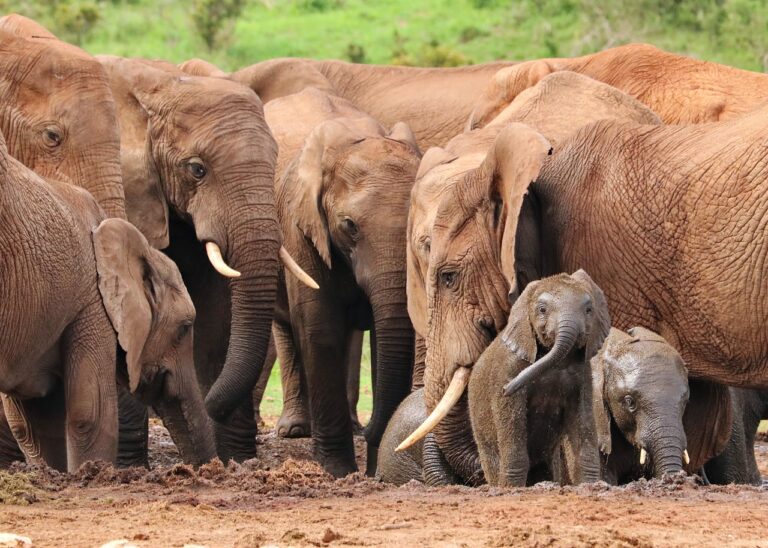
Visiting a wildlife sanctuary is a thrilling experience, for newbies and seasoned wildlife enthusiasts alike. The joy of seeing animals laze around, and exhibit natural behavior in their habitats is genuinely gratifying.

Wildlife sanctuaries are a far cry away from the cruel zoo infrastructure, where animals are kept in cramped conditions, with little or no effort to make their life better. Zoos are also overcrowded, full of people who don’t think twice before teasing the poor miserable animals.

A wildlife sanctuary offers the ideal atmosphere. There are designated car routes, where one can travel in an open-top jeep, and view animals. However, thanks to sheer popularity, sanctuaries have started getting crowded as well.

It isn’t unusual to see a long line of jeeps and other safari vehicles, with people craning to get a look at the elusive exotic species found in our forests.

Obviously, the most sought-after animal is the tiger, and people go out of their way just to catch a glimpse of it. If not, seeing a leopard ‘at at least’ is warranted, else what is the use of a safari? The other animals, the herbivores, rarely matter.

Well, the animals one prefers to see is personal preference. Having said that, there are a few ground rules that sanctuary visitors must obey. Follow these rules, not only for your own safety and benefit but also for the sake of the sanctuary and its wild inhabitants.

Dress appropriately: Clothes that cover your arms and legs are preferred, to keep away bugs and insects, or branches that can leave scratches. Stay away from bright clothing, or attire that has trinkets/noisy bells and tassels. Blending in with the surroundings is desired when you are in the animal’s habitat, so as not to startle/surprise them.

Do not interact with wildlife: Do not make sounds trying to attract the animal’s attention. You are there to observe them, and not the other way around. If you see a hunt in progress, do not interfere. If you find an injured animal, call the necessary authorities. Most importantly, if you come across a carcass, do not attempt to disembark from your vehicle and approach it. It could be a fresh kill, and the carnivore that finds you near it will not be very pleased.

Maintain decorum: This is very important, as you are in the animal’s home. Do not talk loudly, scream or shout, or be a general nuisance. Remember to obey the entrance and exit timings of the park. They are there for a purpose. Most carnivores hunt at night, and you wouldn’t want to find yourself in an unfortunate situation.

Respect the surroundings: Needless to say, the jungle should be treated with absolute respect. Do not get down from your transport to pick up souvenirs like bird feathers, or stones. Do not try and light a fire, or smoke inside the sanctuary premises. Do not try and set up camp in areas where it isn’t permitted. Most importantly, do not litter. Carry a separate bag to collect your litter, and dispose of it in a safe location, away from the jungle.

Photography etiquette: Do not try getting close to animals for a perfect shot, as it can provoke/scare them, and be considerate towards fellow safari-travelers, and refrain from spending hours trying to get a “perfect photo.” Most importantly, do not publish everything you have, on the internet. It has been reported, that poachers use photographs that tourists post online, to find the exact locations of specific animals. While you should take photos and document your safari, exercise some caution to make sure that your prize picture doesn’t put a target on the animal’s back.

National parks and sanctuaries are supposed to be a space just for the animals because humans have shamelessly eroded their habitat over the years. We are lucky that they exist so that we can go and observe these animals thrive in their natural habitat. Let us keep enjoying the beautiful and unique sights and sounds that they provide, never forgetting that we must respect it always, at all costs!

omicron variant: India will not get African Cheetahs this year

The team of experts delegated to carry out the project was about to leave for Namibia in November but had to return from the airport as travel restrictions kicked in the same day

Kuno National Park in Madhya Pradesh was all prepped to welcome the African cheetahs — a project that has been a decade in the making — this year. The project has now been postponed, as the new coronavirus variant of concern omicron prompted travel restrictions.

The team of experts delegated to carry out the project was about to leave for Namibia in November but had to return from the airport as travel restrictions kicked in the same day, Yadvendradev Jhala, dean, Wildlife Institute of India (WII), told Down to Earth.

The team is likely to visit the country early next year.

“We are planning to go in the second week of January 2022, but it depends on the situation. We do not have a deadline for the relocation as yet. The process of relocation will only start once the governments of the two countries talk and finalize the same,” said Jhala.

The 8-10 pairs of cheetahs were supposed to arrive in India in November 2021, but the project was delayed as floods in August disrupted preparations to build proper enclosures for them.

Principal Chief Conservator of Forests, Madhya Pradesh, Alok Kumar, said: “Kuno will be ready to receive the new guests soon as preparations are on the verge of completion”.

Prakash Kumar Varma, divisional forest officer, told DTE: “We have finished the construction of the six watchtowers. The 12-km-long integrated fence will also be completed soon. Around 11 km of the fence has been erected and the next 1 km will be done in the next seven days. The fence has been built to keep away predators.”

The park authorities were also supposed to build two culverts to ensure a proper supply of water to the big cats.

“The water pipeline has been dug and only the pipes need to be laid. The work will be completed in the next two weeks,” he added.

Varma added that the authorities have also set up surveillance cameras to monitor the cheetahs.

The state forest department had also identified some landscape changes that needed to be done to remove obstacles from the cheetahs’ path of prey.

“We have introduced palatable grasses like marble grass and theme grass as well as some wild legumes. We have removed thorny bushes and other invasive species from their line of the path. This was done well before July,” he said.

He added that internal fencing needs to be set up to allow the cheetahs to prey on the herbivores. “That will be done once the WII team comes for supervision and gives us a new plan to erect internal partitions,” he said.

Varma hinted at the possibility of bringing in more chitals from Narsinghgarh Wildlife Sanctuary, Madhya Pradesh.

“We may bring around 150 chitals for the cheetahs to prey on. This is for the wildlife warden to decide. However, it will not impact the planning for bringing in the cheetahs to Kuno. It is just an idea,” he said.

Why giant pandas stay fat despite consuming a low-fat diet

0

A certain microorganism in the bear’s gut could be producing fat for its host, keeping them chubby despite being on a low-fat and high-fibre diet, according to a new report. 

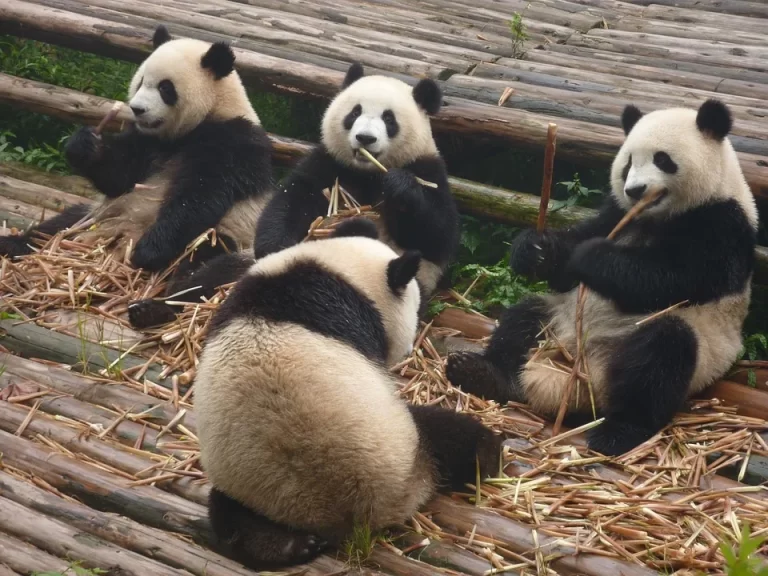
Giant pandas are herbivores. Their diet mainly consists of bamboo leaves and shoots.

From late August to April, they chew on fibrous leaves containing large amounts of hemicellulose and cellulose. The rest of the year, young shoots rich in proteins become the animal’s staple diet.

However, both leaves and shoots contain little fat. “Fat storage is important for animals that must regularly subsist on low-quality foods, as well as for many life events, including seasonal migration, gestation, and reproduction,” researchers wrote in the study published in Cell Reports.

A diet shift appears to influence the giant pandas’ chubbiness. For example, the daily body mass gain is significantly higher during the shoot-eating season than the leaf-eating one.

The gut microbial residents also vary. “We’ve known these pandas have a different set of gut microbiota during the shoot-eating season for a long time, and it’s very obvious that they are chubbier during this time of the year,” Guangping Huang from the Institute of Zoology, Chinese Academy of Sciences and first author of the study, said.

So, the next question was investigating whether gut microbes induce body mass changes.

This led scientists to Qinling, a mountain range in China. The team compared the gut microbial composition of pandas between the leaf- and shoot-eating sessions.

Their analysis showed that the gut hosted significantly higher levels of Clostridium butyricum during the shoot-eating season.

They suspected that this bacterium could be producing compounds that affect giant pandas’ metabolism.

“For endangered and vulnerable wild animals, we can’t really run tests on them directly,” Huang said.

So, they turned to faecal microbial transplantation, which is increasingly helping scientists understand the physiological significance of the gut microbiome.

Huang and his colleagues transplanted faeces from pandas into mice that lacked microbes. These germ-free mice consumed a bamboo-based diet for the following three weeks.

Their analysis showed that mice that received faeces collected during the shoot-eating season gained significantly more weight and had more fat than their counterparts who acquired stool from the leaf-eating season.

Further tests revealed that C. butyricum produces a compound called butyrate. This metabolic by-product increased the levels of a gene Per2, which further accelerates lipid synthesis and storage.

Next, the team plans to identify more gut microorganisms and understand their role in the animal’s health. “Identifying what bacteria are beneficial for animals is very important because one day we may be able to treat some diseases with probiotics,” Huang said.

Odisha can see highest human casualties due to elephant conflict this year: Experts

Odisha is continuing to grant mining leases in elephant habitats despite human deaths from conflict with elephants, say experts

Odisha can see the highest-ever human casualties due to human-elephant conflict (HEC) in 2021-2022 than the years before, experts have warned.

Some 97 people have been killed in HEC from March 2021 to January 18, 2022. There have been 96 injuries. There are still two months to go before 2021-2022 gets over.

“HEC has been raging during the last six weeks across all elephant-range districts of the state, with more elephants entering villages in search of food,” Biswajit Mohanty, the secretary of Wildlife Society of Odisha, a non-profit, said.

“We could probably see more human casualties than 2020-21, which recorded 106 human deaths and 119 injuries. Incidentally, the highest number of human deaths was in 2019-20 in which 115 people were killed and 132 were injured,” Mohanty added.

downtoearth.org.in

Sundargarh has recorded the highest human deaths due to HEC this year: 21 of the total 97 deaths. It is followed by Keonjhar (12) where rampant mining is permitted by the forest department.

“Due to uncontrolled mining activity, the stressed elephants are angry and enter villages in search of food, killing locals in the process. Every mining proposal in dense forests that are elephant habitat and feeding grounds has been cleared by the department,” Mohanty added.

Dhenkanal, which has a high number of black stone and laterite stone quarries, has recorded 11 human deaths. It is followed by Angul (10) where coal mining expansion in elephant forests and large steel industries has led to a jump in attacks.

“The figures are very alarming. In the last three years, we have witnessed approximately one HEC every two days and a human has got killed every three days. Such a high number of human casualties and at such frequency had never been recorded in the past. It is one of the highest in the country,” Mohanty said.

He added that the Odisha forest department had failed to control the HEC despite crores of rupees spent on elephant drives.

“The department regularly pays private consultants high fees to prepare mitigation plans which remain on paper. Key measures that would save human lives and elephants like controlling mining and quarrying are never executed. Rather, more mining clearances are issued by the department,” Mohanty said.

Preventing casualties 

Mohanty gave a number of suggestions to prevent human deaths due to HEC.

He noted that 60 percent of HEC involved tuskers. It was possible to prevent these confrontations if tuskers were identified and continuously tracked by expert trackers.

“Tracking is not happening since most trackers are actually deployed on other duties,” Mohanty said.

Humans encountered elephants early in the morning while going out to relieve themselves in 50 percent of the cases. The forest department should convince people to use toilets built under the Swachh Bharat Mission, Mohanty said.

Local youth teased elephant herds who then vented their anger on old people who could not run. Some casualties had occurred while people were taking selfies with elephants.

“The forest department must prevent this harassment by putting up warning signboards and punishing offenders,” Mohanty said.

Nearly 25 percent of human casualties happened when the walls of huts were toppled by elephants to raid paddy and liquor. A massive door-to-door campaign needed to be launched by the forest department to make people aware of the danger of storing food grains and liquor in bedrooms, Mohanty said.

The forest department must prevent people from collecting fruits from reserve forests and sanctuaries so that there is enough left for elephants’ consumption.

Discoms should strengthen power supply poles, raise power lines to the stipulated 5.5 meters in height and fix earth leakage circuit breakers instead of abruptly cutting off power.

Some 611 elephants have died in Odisha from April 2014 to January 18, 2022. Of these, 191 have died unnatural deaths mainly due to electrocution (90), poaching and poisoning (77), and train and roadkill (24).

The cause of death of 143 elephants could not be ascertained, since the carcasses were in a decomposed state.

All you need to know about tricolor, calico or tortoiseshell cats

0

What is a calico, tricolor, or tortoiseshell cat?

Contrary to what one might think, calicos do not belong to a specific race. This name simply designates cats that have a particular coat pattern. A calico can therefore be a Maine coon, an American Shorthair, an Arabian Mau, a Japanese Bobtail, or a Siberian cat.

For a feline to be considered calico, its coat must be made up of three distinct colors (or their variations): black, orange, and white.

Each tricolor feline has its own patterns. It’s a bit like fingerprints. It is therefore impossible to find two calico cats with the same pattern. This is true even for those from the same litter.

What are the different types of tricolor cats?

WSON Team

Tricolor cats are split into 3 large families according to the color variations of their coats. There are:

  • Calico cats
  • Tortoiseshell cats
  • Tabby cats

Calico cats are felines with mainly white coats and orange and black (or grey) patches. The white appears predominantly on the belly, chin, and chest.

Tortoiseshell cats have a coat with an asymmetrical color mix. They have very little white in their fur and the other colors have much lighter tones compared to those found in standard calicos. Black is generally predominant for tortoiseshell coats.

Tabby cats also have a similar appearance to calico cats. Their coat has a white base with softened spots: gray, light orange, cream, or buff.

What are the personality traits of a tricolor cat?

As calicos do not belong to a specific race, it is very difficult, if not impossible, to say precisely how they typically behave.

However, according to a survey conducted by researchers at the University of California (results published in the Journal of Applied Animal Welfare Science in 2016), there is a link between the color of a cat’s coat and its temperament. According to this study, tricolor cats are rather irritable and temperamental. They are inclined to be aggressive towards humans in certain specific situations:

  • during daily interactions
  • when carried in someone’s arms
  • when taken to the vet

However, these conclusions cannot be generalized, as they are based solely on the information provided by a limited number of owners of tricolor cats. These felines are very different from each other and may therefore have completely different character traits.

Remember that their personality depends on several variable factors such as the environment, training, physical fitness, and socialization.

Tricolor, calico, or tortoiseshell cats: felines with fascinating genetics

WSON Team

If calico, tabby, and tortoiseshell cats are not a cat breed, then where do tricolor felines come from? The answer lies in their DNA. This is because, in felines, the color of the coat is closely related to sex. In other words, the genes responsible for the coloring of a cat’s fur are found in its sex chromosomes (except for the white color gene which is expressed independently).

Just like us, our furry companions have two sex chromosomes: XX for females and XY for males. However, the genetic code that is responsible for the black or orange coloration of their coat is found in the X chromosome. As a general rule, only one of these colors is expressed in cats (in addition to white if the gene carrying it is expressed).

Females can be both colors since they have two X chromosomes. The tricolor cat phenomenon thus occurs when all the color genes are expressed in a cat: the two colors of the X chromosomes in addition to the white color which is independent. It is actually a genetic abnormality that occurs by pure chance. However, because of its nature, it only affects females or almost only females.

Male tricolor cats are generally sterile

Males with a tricolor coat are carriers of another extremely rare chromosomal abnormality. Instead of having two sex chromosomes (XY), they have three (XXY). This is called Klinefelter’s syndrome. Since there are two X chromosomes, all the colors they carry can be expressed.

In general, animals with Klinefelter’s syndrome have serious health problems that hinder their growth. They are often sterile.

It is impossible to intentionally breed calico cats

The chromosomal abnormality that results in a tricolor cat is not transmissible. In other words, the kittens of a tricolor cat will not systematically inherit the appearance of their parents. In order to be tricolored, they must themselves be carriers of the genetic anomaly.

For this reason, it is impossible to intentionally raise a family of tricolor cats. Even if one crosses two calicos, the appearance of their kittens simply cannot be predicted.

Fun facts about Tricolor cats

What makes tricolor cats special is the mystery that surrounds them. Here are a few unusual facts about these unique felines.

Calico cats represent a state

The calico cat is one of the symbols of the state of Maryland in the United States. It was given this status on October 1, 2001, because of its tricolor fur (orange, black, and white), which is reminiscent of the seal of Maryland.

The calico cat is considered a good-luck charm

Calicos are venerated in many countries of the world. For example, in Japan, they are considered lucky charms. In this culture, having a calico-type feline at home brings luck, happiness, and prosperity. Its presence is also said to be a protection against evil spirits. Thus, every September 29th, this pet is celebrated in Japan.

In Ireland as well, the calico is seen as a mythical animal. According to Irish folklore, they have the ability to cure warts with their tails.

Tricolor cats at a glance

These cats do not come from or belong to a specific breed. Their tricolor coat is due to a genetic mutation that is most often observed in females. Because of this, it is almost impossible to mention any character traits specific to these felines.