Melting sea ice forces polar bears to travel farther for food

0

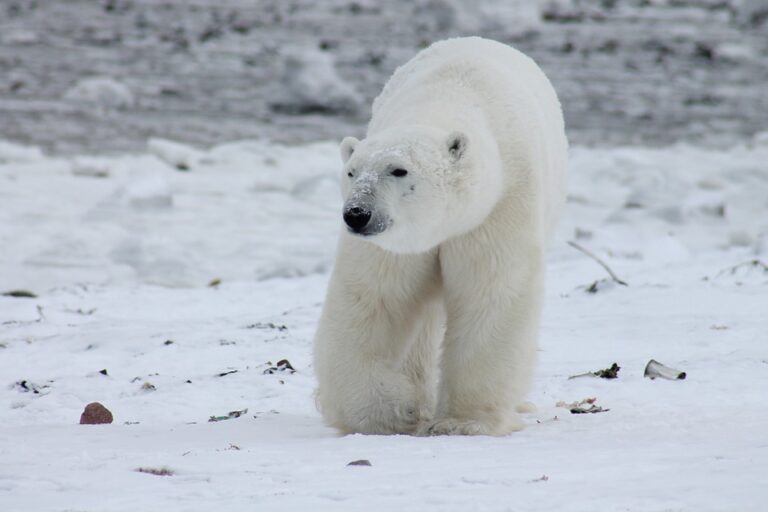
In recent years, polar bears in the Beaufort Sea have had to travel far outside of their traditional arctic hunting grounds which has contributed to an almost 30% decrease in their population.

The bears’ home range, or the amount of space they need for food and other resources, was around 64% larger from 1999-2016 than it was in 1986-1998, according to a recent study in the journal Ecosphere.

“Having to travel farther means these bears are expending more energy which can threaten their survival,” said Anthony Pagano, a postdoctoral researcher in Washington State University’s School of the Environment and lead author of the study. “If we want to preserve the habitat of these amazing mammals, then we need to focus on the root of the problem, which is slowing global climate change.”

For the study, Pagano and colleagues from the U.S. Geological Survey used satellite tracking data to analyze the movement patterns of female polar bears from 1986-2016 in the Beaufort Sea area north of Alaska.

Their work showed over the last two decades polar bears are having to travel farther north of their traditional hunting grounds on the continental shelf to remain on their receding sea ice habitat.

Extending around 100 miles north of Alaska and Canada, the continental shelf is a shallow water habitat that contains plenty of fish for the bears’ favorite prey, seals.

During the early summer when seals are weaning their pups and most vulnerable to attack, polar bears will often double their body weight from eating the fatty meat.

The researchers’ data shows that as the sea ice over the continental shelf continues to recede earlier and further; the bears are being displaced from this primary foraging habitat and traveling further north into deeper waters where there are fewer seals to prey on.

“The combined impact of having to move farther and farther north with the ice in the summer and then having to move back in the fall and winter as the ice freezes is taking a major toll,” Pagano said. “Our work highlights the worrying impact of sea ice decline on polar bear movement patterns.”

Another interesting finding of the study is that around 20% of the polar bear population in the Beaufort Sea is foregoing their traditional sea ice hunting grounds altogether in the summer and fall. These bears are moving inland along the Alaskan and Canadian coast looking for food such as carrion, berries, and sometimes even bowhead whale carcasses that are left on the shore by indigenous residents that hunt the large aquatic mammals.

“Sometimes you’ll have 50 to 100 polar bears that congregate around these whale carcasses and compete with each other for food,” Pagano said. “As more and more bears move on land, I suspect there’ll be a lot more competition for these food resources and we’ll probably start seeing further decreases in abundance and survival.”

Moving forward, Pagano and his colleagues with the U.S Geological Survey plan to conduct further studies of the polar bears moving inland to get a better idea of how they are coping with their new terrestrial habitat.

He said the best thing humans can do to help preserve the southern Beaufort Sea’s 800 or so remaining polar bears is to focus on curbing global carbon emissions which are the main cause behind receding arctic sea ice.

Recent modeling work has shown that if regulations are enacted to reduce these emissions to avoid global warming greater than 2°C or 3.6°F then it could drastically slow the decline of polar bear habitat in the arctic which would, in turn, help these animals to survive.

“Coming across a polar bear while flying over the arctic in a helicopter is a surreal experience,” Pagano said. “They are incredibly massive and impressive. It is amazing to observe this animal that is so uniquely adapted to exist in this harsh arctic environment. They are worth the effort it will take to preserve them.”

India Reports Drastic Drop in Wildlife Crime Incidents in 2021: WCCB

Incidents of wildlife crime have come down drastically in the country in the current year, owing to the stringent measures adopted by the Wildlife Crime Control Bureau (WCCB).

According to the data accessed by IANS, there has been a drop of 127 per cent this year in comparison to 2020. As per the data available with WCCB, provided by state forest and police authorities, a total number of 281 wildlife crime cases were registered this year. In 2020, they stood at 601 and a year before in 2019, at 805.

The second wave of the COVID-19 pandemic too played a major role in the reduction in such incidents.

The Wildlife Crime Control Bureau has taken several steps to prevent illegal trafficking of endangered animals and wildlife species and to conserve the flora and fauna of the country.

From time to time, the department is conceiving, planning and coordinating nationwide ‘species-specific operations’ like Save Kurma, Turtshield, thunder series, etc, with the focus on coordinated action on transnational wildlife crime particularly along the borders of India with Bangladesh, Bhutan, Myanmar and Nepal.

The WCCB has been conducting joint operations with state enforcement agencies to apprehend criminals involved in smuggling wildlife. A total of 16 species-specific operations have been carried out till now in collaboration with Interpol and other enforcement agencies.

In the last 7 years from 2014 to 2021, the WCCB conducted 717 joint operations resulting in the arrest of 1488 wildlife criminals and profiling of 3248 wildlife offenders. There were large seizures of ivory, rhino horns, tiger skins/body parts/ bones, leopard skins, pangolins, turtles, mongoose hair, monitor lizards, shark fins, sea horses and others.

According to the data, 153 joint operations were conducted in 2019-20 which led to the arrest of 344 wildlife criminals while in 2020-21, 101 joint operations resulted in the arrest of 304 criminals and in 2021-22 till September, 74 joint operations have been conducted in which 202 wildlife criminals have been apprehended.

The proactive approach of the WCCB seems to be instilling a sense of fear in the minds of the criminals involved in such activities.

Wildlife crime is considered an environmental offence. Recently, the Ministry of Environment, Forests and Climate Change too released the overall data but it was only till 2020. The Crime in India report released for 2020 indicated that the number of cases registered for environment-related offences has increased from 34,676 in 2019 to 61,767 in 2020.

Apart from the WCCB’s tough approach towards the criminals, it is conducting sensitization programmes for officials of the Border Guarding Forces, Customs, Central Industrial Security Force (CISF), Judicial officers, RPF, GRP and other forces/ stakeholders.

In 2020-21, 108 such programmes were conducted and 8603 officials sensitised. This year, till September, 76 online webinars have been conducted through which 4480 stakeholders have been sensitised.

Heartbreaking Pics Show Impact Of Kenya’s Drought On Its Giraffe Population

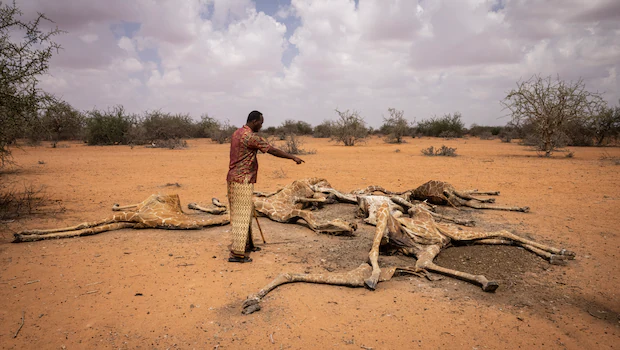
Heartbreaking photos have captured the impact of Kenya’s drought on the country’s giraffe population. One photo, in particular, has been widely shared online – it shows six giraffes lying dead inside Sabuli Wildlife Conservancy in Wajir. The photo was reportedly taken after the giraffes, weak from lack of food and water, died after they “got stuck in the mud as they tried to drink from a nearly dried-up reservoir nearby.”

Their bodies were moved to a different location where the photograph was taken. The bodies were moved to prevent contamination of reservoir water.

According to Al Jazeera, much of Kenya’s north has received less than 30 percent of normal rainfall since September, leading to an intense drought in the region. The lack of rainfall has had a devastating impact on the region’s wildlife and exacerbated food and water shortages, besides pushing pastoralist communities and their livestock to the brink.

by Ed Ram/Getty Images

But Ibrahim Ali, from the Bour-Algi giraffe sanctuary, says that wild animals are most at risk. “Domesticated animals were being assisted but not wildlife, and now they are suffering,” Mr. Ali told local news website The Star. He said that farming activities along the river have blocked giraffes from accessing water, worsening the situation.

Another photo shows the assistant chief of Eyrib village, Abdi Karim, looking at the bodies of six giraffes that lie on the outskirts of Eyrib village in Sabuli Wildlife Conservancy. The photograph was taken on December 10. The report in The Star said that 4,000 giraffes in nearby Garissa county were at risk of being wiped out because of the drought.

Kenya President Uhuru Kenyatta declared the drought a national disaster in September. Meanwhile, Kenya’s National Drought Management Authority last week announced an Emergency Relief Cash Transfer Program for 2.5 million people affected by the drought.

Translocation brings white rhinos to Rwanda, a new land for an old species

The relocation is aimed at establishing the species in a new range state and ensuring its survival into the future.

Traveling these days isn’t easy. When it involves moving 30 rhinos by air across a continent, it gets even trickier.

“Anything can change in seconds,” Jes Gruner, Rwanda regional operations manager, told Mongabay in a phone interview. “The aircraft charter delayed us by eight hours, unfortunately, due to technical issues. We already had the rhinos in the crates … but the team got together and sorted it very quickly.”

A delayed flight was just one of many challenges. Before the rhinos even got on the plane, Gruner and his team had worked for years to organize their translocation from South Africa to Rwanda, and recently battled COVID-19-related delays and setbacks. Then they had to figure out how to safely sedate the animals and get them into crates on a tight schedule. And once they arrived in Rwanda, the rhinos had to be loaded onto trucks and driven another six hours to Akagera National Park, a 1,120-square-kilometer (430-square-mile) stretch of wetlands, woodlands, and savannas.

But when the trucks drove the 30 rhinos into the park on Nov. 29, Gruner knew the toil and stress had paid off.

“It’s a good feeling,” Gruner said. “When you’re driving through the communities, and they’re welcoming the rhinos and … showing they’re committed to conservation, it just makes all the work feel worthwhile. That’s a human-to-human feeling, but I wish the rhinos could feel that, too, because they are coming to a place where they truly are welcome.”

The 30 white rhinos (Ceratotherium simum) — 19 females and 11 males — were moved from the andBeyond Phinda Private Game Reserve in KwaZulu-Natal province, South Africa, in an effort to establish a new population in Rwanda that would help ensure the species’ survival into the future. This was the largest single translocation of the species, according to the NGO African Parks, which helps to manage Akagera.

White rhinos are currently considered to be a near-threatened species by the IUCN, and their numbers continue to decrease due to illegal poaching for their horns, which are a sought-after commodity in traditional Chinese medicine.

One subspecies of the white rhino, the northern white rhino (C. s. cottoni), only has two individuals left in the world: a mother and daughter pair at Ol Pejeta Conservancy in Kenya. The other subspecies, the southern white rhino (C. s. simum), to which the 30 new Akagera residents belong, has a population of about 18,000 individuals across five primary countries: South Africa, Namibia, Kenya, Botswana, and Zimbabwe.

“Their numbers are on a knife-edge and they can go either way,” Gruner said. “So we really need to try and do our best to ensure that they go in a positive way.”

In 2010, African Parks and the Rwanda Development Board (RDB) helped reestablish Akagera National Park after the 1994 Rwandan genocide, which had nearly destroyed the park. Since then, the park has been transformed into a refuge for Rwanda’s wildlife, and according to African Parks, not a single high-value animal has been poached there for the past 11 years. The park has also acquired many translocated animals, including two lions (Panthera leo) in 2015, 18 critically endangered black rhinos (Diceros bicornis) in 2017, and another five black rhinos from European zoos in 2019. This latest translocation of white rhinos was a partnership between African Parks, RDB, andBeyond, and the Howard G. Buffett Foundation.

White rhinos have not been present in Akagera in recent history, so their introduction to the national park is a first step in creating a new range state for the species, according to Gruner.

Ladies Ndahiriwe, park manager for Akagera, said the national park was an ideal choice for the white rhinos because it provides a suitable and safe habitat for them.

“We have everything,” Ndahiriwe told Mongabay in a phone interview. “We’ve put everything in place: law enforcement, the security, we even made an assessment to see [that the appropriate] grass and food are here. I think it’s a perfect place to keep these animals, who are specifically in danger, because [Akagera is] very secure.”

Eugene Mutangana, head of conservation for RDB, said he expects this translocation to be as successful as previous ones, but said it will depend on how the white rhinos adapt to their new surroundings and if they reproduce.

“We are happy with the growth of the numbers of each species that we translocated, so we envision the same [for the white rhinos],” Mutangana told Mongabay in a video call. “We are confident that it will be a success in the coming years.”

Markus Hofmeyr, a member of the IUCN’s African Rhino Specialist Group who assisted with the rhino translocation as a wildlife veterinarian, says this move is significant since it could potentially help rhinos be reestablished in other areas in Rwanda besides Akagera.

“The key importance of Rwanda is that there is now a newly settled population of white and black rhino in East Africa and if their numbers grow, then the Rwanda population can be a source of rhino for [other] areas regionally as more parks become available after recovery and securing to reintroduce rhino species into their historical range,” Hofmeyr told Mongabay in an email.

Gruner says the rhinos have been doing “really well” since their arrival in Akagera, and that the team will be closely monitoring their progress.

“They’re very, very calm and moving together,” Gruner says. “It’s looking really positive … but by no means are we safe and dry. We have a long way to go. I’d say 70% of the work is done. The other 30% now is making sure they really do acclimatize — but it’s looking positive.”

A dedicated team of rhino rangers and trackers will be keeping tabs on the new white rhino population to ensure their safety and monitor their health and behavior, says Drew Bantlin, conservation and research manager at Akagera. He added it’s not just security that has kept the park safe for so many years — it’s the support of the local communities.

Most dog breeds highly inbred

The study suggests inbreeding contributes to increases in disease and health care costs, The majority of dog breeds are highly inbred, contributing to an increase in disease and health care costs throughout their lifespan, according to new research.

Dog breeds are often recognized for distinctive traits — the short legs of a dachshund, wrinkled face of a pug, spotted coat of a Dalmatian. Unfortunately, the genetics that gives various breeds their particular attributes are often the result of inbreeding.

In a recent study published in Canine Medicine and Genetics, an international team of researchers led by the University of California, Davis, veterinary geneticist Danika Bannasch show that the majority of canine breeds are highly inbred, contributing to an increase in disease and health care costs throughout their lifespan.

“It’s amazing how inbreeding seems to matter to health,” Bannasch said. “While previous studies have shown that small dogs live longer than large dogs, no one had previously reported on morbidity or the presence of disease. This study revealed that if dogs are of smaller size and not inbred, they are much healthier than larger dogs with high inbreeding.”

Inbreeding affects health

The average inbreeding based on genetic analysis across 227 breeds was close to 25% or the equivalent of sharing the same genetic material with a full sibling. These are levels considered well above what would be safe for either humans or wild animal populations. In humans, high levels of inbreeding (3-6%) have been associated with an increased prevalence of complex diseases as well as other conditions.

“Data from other species, combined with strong breed predispositions to complex diseases like cancer and autoimmune diseases, highlight the relevance of high inbreeding in dogs to their health,” said Bannasch, who also serves as the Maxine Adler Endowed Chair in Genetics at the UC Davis School of Veterinary Medicine.

The researchers partnered with Wisdom Health Genetics, a world leader in pet genetics, to obtain the largest sample size possible for analysis. Wisdom Health’s database is the largest dog DNA database in the world, helping researchers collect data from 49,378 dogs across 227 breeds — primarily from European sources.

Some breeds more inbred

So, what makes a dog breed more inbred than others? Bannasch explained that it’s often a combination of a small founding population followed by strong selection for particular traits in a breed — often based on looks rather than purpose. While she has always had an interest in the population structure of some of these breeds, she became particularly interested in the Danish-Swedish Farmdog several years ago. She fell in love with their compact size, disposition, and intelligence, and ended up importing one from Sweden.

Bannasch discovered that Danish-Swedish Farmdogs have a low level of inbreeding based on their history of a relatively large founding population of 200, and being bred for function, rather than a strong artificial selection for looks. And according to the insurance health data on breeds collected from Agria Insurance Sweden and hosted online by the International Partnership for Dogs, the farm dog is one of the healthiest breeds.

The study also revealed a significant difference in morbidity between brachycephalic (short skull and snout) and non-brachycephalic breeds. While that finding wasn’t unexpected, the researchers removed brachycephalic breeds from the final analysis on the effects of inbreeding on health.

Preserving genetic diversity

In the end, Bannasch said she isn’t sure there is a way out of inbred breeds. People have recognized that creating matches based solely on pedigrees is misleading. The inbreeding calculators don’t go back far enough in a dog’s genetic line, and that method doesn’t improve overall high levels of population inbreeding.

There are other measures that can be taken to preserve the genetic diversity and health of a breed, she said. They include careful management of breeding populations to avoid additional loss of existing genetic diversity, through breeder education and monitoring of inbreeding levels enabled by direct genotyping technologies.

Outcrosses are being proposed or have already been carried out for some breeds and conditions as a measure to increase genetic diversity, but care must be taken to consider if these will effectively increase overall breed diversity and therefore reduce inbreeding, Bannasch said. In particular, in the few breeds with low inbreeding levels, every effort should be made to maintain the genetic diversity that is present.

Other UC Davis authors include Thomas Famula, Kevin Batcher, Noa Safra, Sara Thomasy, and Robert Rebhun. Contributors from Wisdom Health Genetics include Jonas Donner, Heidi Anderson, and Leena Honkanen.

This work was supported by the International Canine Health Award and the Maxine Adler Endowed Chair Fund.