
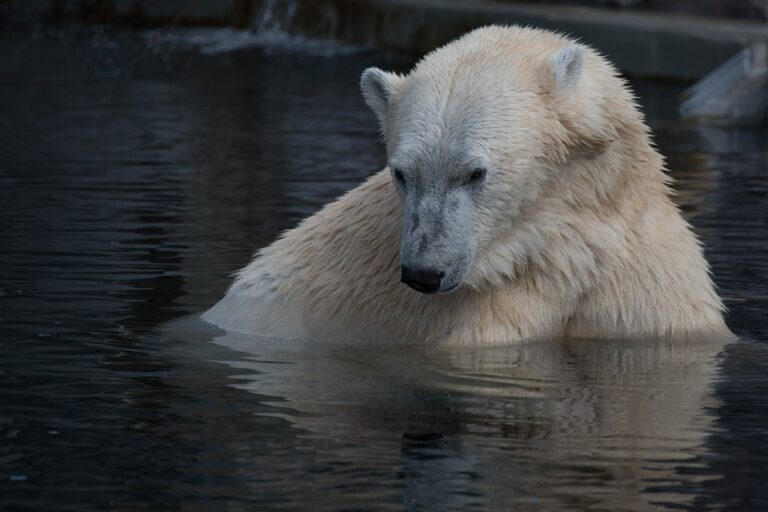
Polar bear diet may indicate prey distribution changes due to climate shifts

How are warming temperatures and a loss of sea ice affecting polar bears and their marine mammal prey in the Arctic? A York University-led research team used a novel approach to the question by monitoring what polar bears eat across Nunavut and where they are catching their prey.

They found that polar bears can be used as indicators of environmental shifts and highlight how these changes are disturbing the normal distribution of marine mammal prey populations in the Arctic.

The researchers, including Faculty of Science Ph.D. Candidate Melissa Galicia, who led the research, and Professor Gregory Thiemann of the Faculty of Environmental and Urban Change, have found polar bears, originally thought to eat mainly ringed and bearded seals, are actually flexible eaters. They will eat what’s readily available and this makes them ideal as a monitoring tool to track environmental changes in the Arctic.

“Polar bears need the sea ice to hunt. When there is a reduction in the sea ice, they’re hunting less or they’re potentially hunting different prey species,” says Galicia. “Prey species, like whales and seals, also need certain habitat conditions and because of environmental changes in the Arctic, some marine mammals, such as prey species of bears, are redistributing. You’re getting an increase in more sub-Arctic species, like killer whales for instance.”

The researchers analyzed harvest samples of polar bears from across Nunavut, provided by subsistence hunters over a period of about eight years, and identified spatial hot spots of prey species. The study suggests polar bear diet may provide early evidence of changes in the distribution of mammals due to climate change.

“I’m getting a large geographic representation of bears, especially in areas that tend to be less studied,” says Galicia, who was able to analyze the fatty acids, such as omega 3s and omega 6s, in the fat tissue of bears.

“Each bear will have a specific fatty acid signature, a kind of fingerprint for individual bears and because of that you can see what that particular individual is eating and what percentage of their diet that represents.”

They found bowhead whale carcasses were increasingly becoming more common in the polar bear diet potentially linked to killer whales venturing further north and staying for longer periods of time.

The researchers say changes brought on by a warming climate — the Arctic ecosystem is experiencing climate warming up to three times faster than any other region — will likely force widespread species redistribution, particularly in polar environments. The polar bears in Nunavut aren’t experiencing climate changes to the same degree as some subpopulations in western Hudson’s Bay or Beaufort Sea areas, but ultimately that will likely change.

“As temperatures across the Arctic warm and sea ice loss increases, there will be profound cascading ecological consequences. What’s not known is how that will affect species, such as seals and whales, but by monitoring the seasonal prey consumption of polar bears, scientists can better keep track of where marine mammal prey species are showing up and their seasonal distribution,” says Thiemann.

There is currently little information on the abundance and distribution of marine mammals across the Arctic so this study offers a way to gain further insight and highlight potential range shifts.

The researchers say future studies of polar bear diets should include prey species not typically found in the region and help predict the severity and influence of climate-induced change

The Miracle of A serene place in a city of heritage: Dada Hari ni Vav- Ahmedabad

So I’ve been in Ahmedabad for a month and my only excitement about this city was to explore its historical sites as it was named under the world heritage city.

One cannot survive in Ahmedabad because of its extremely hot weather that is 46°c. But my desires could not stop me from checking out this amazing place asarwa Dada Hari ni vav in Ahmedabad.

Sonali Mistry, WSON Team

It was a Sunday morning, quite a sunny day. I and my friends decided to visit ‘Dada Hari ni Vav’ (step well) but they ditched the plan because of the heat. Thus, I decided to go by myself. It took almost half an hour for me to reach there from my home. And the struggle was worth it!

Sonali Mistry, WSON Team

You know there is a moment in your life where you need to go away from all the chaos you have been handling for a long and you decide to leave everything and go somewhere to get peace. Just like that when I arrived at Dada Hari ni Vav, I felt peace. It was so calm and silent, full of light, where you can recharge your mind.

Though, the place inspires a historian, photographer, and thinker in you.https://wildstreakofnature.com/indroda-nature-park-best-place-to-visit-for-kids-near-ahmadabad/

Sonali Mistry, WSON Team

As a historical step well, it is the most complicated structure in Ahmedabad. The place was built during the reign of Mehmud Begda in the year 1501. Dada Hari Vav is an elaborately designed stepped well. The well lies just behind the tomb of Dada Hari. The basic purpose of setting up the well was to provide travelers with cool water and a place for relaxation.

Sonali Mistry, WSON Team

Dada Hari Vav is an octagonal-shaped well, which is located below the ground level. This underground well has been intricately carved in the typical Gujarati designs. Made from fine stonework of Gujarat.

The well bears two inscriptions, one in Sanskrit on the south, and one in Arabic on the north wall, of the first gallery.

The Arabic writing reads:

Sonali Mistry, WSON Team

“This holy and wholesome water; the splendid travelers’ rest-house enclosed on four sides by carved and painted walls, and a grove of fruit trees with their fruit, a well, and a pool of water for the use of man and heist, were built in the reign of the Sultan of the Sultans of the age, established by the grace of God and of the faith, Abul Fath Mahmud Shah, son of Muhammad Shah, son of Ahmed Shah, son of Muhammad Shah, son of Muzaffar Shah the Sultan, may God keep his kingdom. Dated the metropolis of the kingdom the 2nd of Jamadi-ul-awwal in the 26th year of the reign.”

Sonali Mistry, WSON Team

The Sanskrit inscription gives information about the establishment and cost of the stepwell.
Built-in sandstone in Solanki architectural style, the stepwell is five stories deep. Each floor is spacious enough to provide for people to assemble. It was dug deep to access groundwater at that level.

The air and light vents in the roofs at various floors and the landing level are in the form of large openings. From the first story level, three staircases lead to the bottom water level of the well, which is considered a unique feature.

Sonali Mistry, WSON Team

If you are exhausted from regular chores and need a day by yourself to calm your mind Dada Hari ni Vav is the must-visit place. It will take you to ancient times and wake your inner historian up.

Also, read this story: 

Mysteries of whale: An Oceanic Wonder


14 New Species Of Prawn, Lobster Larvae That Look Like ‘Aliens’ In Gulf Of Mexico

The depths of our seas are laden with a multitude of secrets. But as rapid technological advancements make it possible to reach the depths of the oceans, the results are surprising discoveries.

One of the recent ones is related to what sits deep in the waters of the Gulf of Mexico. Scientists have identified 14 different species of larvae that were once believed to be different species that live in the deepest parts of the Gulf of Mexico.

The creatures, which bear alien-like looks, are mostly shrimps and lobsters, according to Heather Bracken-Grissom, one of the co-authors of the study. Bracken-Grissom, an assistant professor at Florida International University, opines that shrimp found in the ocean usually go through multiple larval stages and it’s possible that some of the creatures are going through different stages.

In the study, published in the journal Diversityresearchers wrote that they used DNA barcoding and morphological methods to match the larvae they found to their adult counterparts to identify the larval species.

According to the university’s news release, this is not the first time that Bracken-Grissom has given identity to the deep-sea creatures. In 2012, she was able to identify the species known as Cerataspis monstrosa using the same genetic methods to reveal the miniature-sized creatures they found recently.

Many of the creatures, as per Bracken-Grissom, live in the mesopelagic zone of the ocean, an area between 650 and 3,200 feet (200 to 1,000 meters). She added that upon attaining adulthood, these creatures settle even further down the depths of the ocean.
“Most are prey items for fish, deep-diving marine mammals, and cephalopods, which means they are important to the food chain,” said Bracken-Grissom. The scientists and researchers will continue their studies on the 14 creatures to learn more about their parents,

New Frog Species ‘Adi Cascade’ Discovered In This State

The new species of Cascade Frog has been named Adi Cascade Frog (Amolops adicola) after the Adi hills in Arunachal Pradesh.

A team of biologists from Delhi University, Wildlife Institute of India, and North Carolina Museum of Natural Science (USA) has discovered a new species of frog from the Adi hills Arunachal Pradesh, according to an official statement.

The new species of Cascade Frog has been named Adi Cascade Frog (Amolops adicola) after the Adi hills, which are home to Adi tribes, an indigenous group of people from the Himalayan regions in the state.

The literal meaning of Adi is “hill” or “mountain top”. Historically, this region was also known as Abor Hills.

The findings have been published in a scientific article titled ”Phylogenetic position of the poorly known montane cascade frog Amolops monticola (Ranidae) and description of a new closely related species from Northeast India” in the Journal of Natural History, London, the statement said.

The discovery was made as biologists investigated a group of medium to large-sized Cascade Frogs from Northeast India over the last five years.

Dr. Abhijit Das, from Wildlife Institute of India, Dehradun, said the new species was discovered while revisiting the century-old Adi expedition in 2018 and named after the land of the Adi tribe in Arunachal Pradesh where this species dwells particularly during the post-monsoon season.

According to the researchers, the “Cascade Frogs” is named so because of their preference for small waterfalls or cascades in flowing hill streams. The new species was identified based on multiple criteria, such as external morphology, DNA, and calling pattern.

“This study is once again testament to how little is known about the most threatened animal groups, frogs, in northeastern India. Many frogs in this region are reported to occur widely but, in fact, have relatively small geographical ranges and require special attention for conservation before they go extinct forever. Northeast India is a treasure house of species still unknown to science”, said Delhi University Professor S. D. Biju, the corresponding author of the article.

Gorillas can tell human voices apart

0

Apes react differently to people they know and like than people they don’t like, strangers

Many animals recognize the voices of members of their own species, and some can even recognize those of other species, such as humans. But it turns out a few animals, such as gorillas, can not only recognize familiar voices but also connect those voices to pleasant or not so pleasant memories.

A new study from the University of Georgia is the first to show that gorillas are able to recognize familiar human voices based on their relationship with the speaker.

The researchers found that captive gorillas responded negatively when they heard the voices of people they didn’t know or with whom they’d had negative interactions. Their reaction indicates that the apes likely recognized who the voices belonged to and possibly the nature of their relationship with those individuals.

Although this project focused specifically on gorillas at Zoo Atlanta, the findings, published in the journal Animal Cognition, have wider implications for the captive animals’ wild cousins.

“I worked mostly with wild gorillas, and one downside of working with wild primates is that through the habituation process we could make them much more susceptible to hunters because they become used to seeing and hearing people,” said Roberta Salmi, lead author of the study and director of the Primate Behavioral Ecology Lab in the Franklin College of Arts and Sciences. “If they are actually able to distinguish between people, there is hope.”

Animals can recognize voices

A wide variety of animals appear to be able to recognize and differentiate between voices of their same species. But some can also do that with other species.

“Babies are able, for example, to recognize the voices of their mothers and their scent. That’s wired into animals,” Salmi said. “In the wild, we know that some monkeys also form specific associations with individuals of other species.”

It’s a survival tactic. If a monkey hears and recognizes the distress calls of a known individual, they know something is wrong and can try to hide or escape danger.

But whether undomesticated animals can recognize individual humans is a bit murkier.

Research has shown that dogs and cats can distinguish between their owner’s voice and the voices of others. They can even detect changes in tone — which is the real reason your dog looks so guilty after toppling the garbage can. Rover’s not actually guilt-stricken. But dogs and cats have been domesticated for centuries, creating a close bond between people and their companion animals.

Animals in proximity to people, such as crows, pigeons and even wild elephants, have also been shown to differentiate between voices that they were familiar with and those they weren’t. These studies suggest that being able to differentiate voices and assess the threat level may be important for animals with increased exposure to humans.

Salmi and her team noticed the gorillas responded negatively to the presence of specific people who came into their indoor enclosure. Specifically, the animals seemed to grow agitated at the presence of veterinarians and one maintenance worker. But it was unclear whether the animals were only reacting to visually see the people.

Apes may gauge threats by the familiarity of human voices

Over the course of about six months, the team played the apes audio recordings of three groups: long-term keepers who knew and worked with the gorillas for at least four years and had positive relationships with them; people who the apes knew and had negative interactions with, including veterinarians and the maintenance worker; and people who were unfamiliar to the animals. All the participants said the same phrase, “Good morning. Hello,” which is how keepers typically greet the gorillas.

The apes had minimal reactions to the voices of their keepers. However, when they heard the voices of people they didn’t know or with whom they’d had negative experiences, the gorillas responded with signs of distress, such as increased vigilance and vocalizations.

“One of the first things we saw was something that also happens in the wild: If there’s any sound that seems threatening or unfamiliar, they stopped what they were doing and focused their attention on it,” Salmi said. “It’s something we do too. If it’s not a threatening sound, I keep doing my own business. If I hear that there is someone in my house, I immediately stop what I’m doing to hear what’s going on.”

For gorillas, it’s the first sign of vigilance. After hearing unfamiliar voices or the voices of people with whom they’d had negative interactions, the apes in the study stopped eating their treats or whatever else they were doing and started looking toward the sound to gauge whether the voices were a threat. It was unclear whether the gorillas considered the strangers to be as threatening as the veterinarians and maintenance workers.

“Some primates are able to distinguish and have different reactions to humans, according to whether they are hunters or researchers,” Salmi said. “If wild gorillas are able to distinguish between people who behave differently, not only by sight but also by voice, it would be extremely helpful. It would help me sleep better to know that researchers aren’t making the gorillas more vulnerable to hunters.”

Caroline Jones, who received her doctorate from the Department of Psychology, and Jodi Carrigan, from Zoo Atlanta, are co-authors of the study.