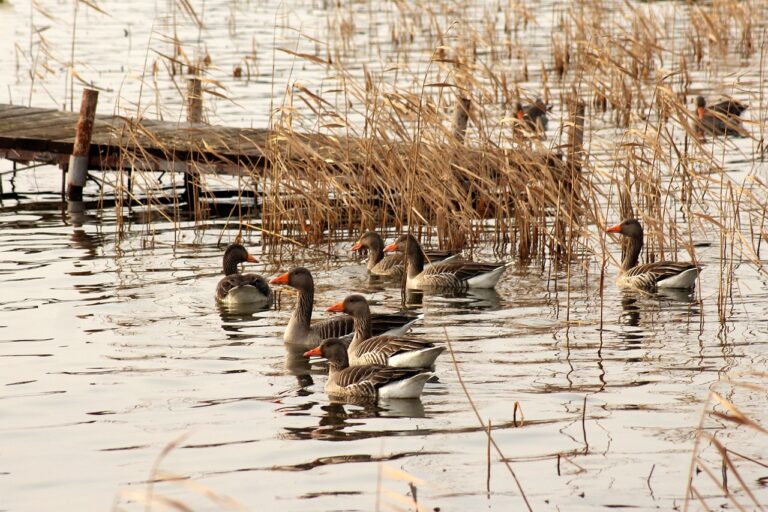
Rampara Wildlife Sanctuary is the wooded area in an arid zone otherwise devoid of any noteworthy tree growth. The shrubby land interspersed with patches of grasses, harbours large number of species of plants, birds and mammals. This was declared a sanctuary in November 1988.
WSON Team
The terrain is plain in the middle of the sanctuary and rising and falling elsewhere. The hillocks on the fringes mark the boundary of the area. The sanctuary is an important area for the preservation of over 280 species of plants, over 130 species of birds and more than 20 species of mammals and equal number of birds species and many reptiles.
Located in Rajkot this wildlife sanctuary covers an area of 15 sq km, which is inhabited by over 20 species of mammals and 130 species of birds.
The most common species found in the reserve are wolf, jackal, hyena, common fox, hare, jungle cat, bluebull along with about 20 different types of snakes.
WSON Team
Surrounded by the birds, partridge, common peafowl, sandgrouse, ring dove, large gray babbler, purple sunbird, yellow-throated sparrow are commonly spotted here. Rampara is also a place where you can spot the biggest antelopes in the country.
The best time to visit Rampara Wildlife Sanctuary is mid October and January
At Vansda animals like Leopard, rhesus macaque, wild boar, hanuman langur, common palm civet, small Indian civet, Indian porcupine, four-horned antelope, barking deer, hyena, jungle cat, flying squirrel, python and Russel’s viper can be spotted.
WSON Team
This is one of the most popular wildlife sanctuaries in Gujarat and is known for sheltering a very vast population of wildlife.
WSON Team
Also about 155 species of birds including the Indian great black woodpecker, yellow back sunbird, pompodour pigeon, malabar trogon, shama, common grey hornbill, jungle babbler and forest spotted owlet (globally threatened) can be seen here. The best time to visit this National Park is between November and March.
wastern Indian state of Gujarat can be defined. This absolutely vivacious state is also one of the wealthiest wildlife destinations in the country. Well, we cannot forget that Gujarat is the only state in India that shelters a sizable population of the Asiatic Lions, which is a threatened species. It is a secure habitat for rare species of blackbuck and the Indian wild ass. The state is also a preferred haunt of many rare and endangered species of migratory birds. Call it a haven for wildlife, Mecca for the ornithologists or paradise for the nature lovers, Gujarat is all in all an ideal place for a wildlife getaway in India. Here is the list of national parks and wildlife sanctuaries that are a must see.
Veravadar Blackbuck National Park
WSON Team
The park is located in the Bhavnagar district of Gujarat and is stretch over an area of about 34 sq km. This is amongst the few places in India, where one can cite a sizable population of Blackbucks. Apart from blackbucks, this national park is the secure habitat for the endangered Indian wolf, Jackal, Indian fox, Jungle cat, Blue bull antelope, Wild pigs, Hares and Rodents. The southern part of the park is ideal for birdwatchers, while the southern border is also the much-loved place of packs of wolves. The best time to visit this Blackbuck National Park is between the month of July and March.
Nalsarovar Bird Sanctuary
WSON Team
One of the largest wetland bird sanctuary of Gujarat, this bird sanctuary is a lake that have over 360 islets. Located near Sanand Village, this bird sanctuary is hailed as the best places to enjoy bird watching. There are 200 species of birds in the lake which is a safe shelter for migratory birds from Europe, Central Asia, Serbia and many other countries. Greater and lesser flamingoes, pelicans, ducks & geese, rails, coots, cranes, cormorants, herons, egrets, storks, ibises, spoonbills, teals, sarus cranes, moorhens and waders can be spotted in the sanctuary. The best time to visit Nalsarovar Bird Sanctuary is from November to April. You can also spot herds of wild ass, mongoose, jungle cat, Indian fox, jackal, wolf and hyena here.
Hingolgadh Nature Education Sanctuary
WSON Team
Hingolgadh Nature Education Sanctuary is situated in Rajkot district and is just 10kms away from Jasdan which was once a princely state. A small sanctuary but worth a visit one and several camps are organised to generate awareness regarding wildlife and its conservation. You get to see Chinkara, Leopard, Flying fox, Hyena and Wolf. Along with 230 species of birds, this sanctuary is also the home to about 19 species of snakes.
Khijadiya Bird Sanctuary
WSON Team
Spread over 6 sq km of area, Khijadiya is amongst the unsurpassed bird sanctuaries in Gujarat. A striking number of 220 species of birds are found in this small area. Situated in the coastal area near Jamnagar, this sanctuary also has marine habitat, fresh water habitat, marshy lands, mangroves, prosopis areas, salt pans, open mudflats, intertidal mudflats, creeks and scrubs sandy beaches covered under its shelter. Along with birds like Pelicans, spoonbill, Indian skimmer, great crested grebe, little grebe, purple moorhen, ducks, coots, cormorants, herons, egrets, storks, ibises, gulls, terns, jacanas, darter and flamingoes, one can spot Jackal, jungle cat, blue bull, mongoose as well here. The best time to visit this bird sanctuary is between October and March.
New metric can help determine when birds fly over a site or stop to refuel or res
Recently published research in the journal Ecology Letters combines these components into a new metric called the stopover-to-passage ratio. This study is the result of a collaboration between researchers at the Smithsonian Migratory Bird Center, Cornell Lab of Ornithology, University of Maryland Center for Environmental Science, Colorado State University, Georgetown University, University of Massachusetts and University of Delaware.
“The stopover-to-passage ratio is an indicator of the number of migrants that stop to rest during migration and those that continue heading north or south, depending on the season. The ratio varies from site to site,” said co-author Kyle Horton, assistant professor at Colorado State University and an alumnus of UD’s College of Agriculture and Natural Resources. “It’s highly useful, from a conservation standpoint, to know if the majority of birds fly over a site or predominantly stop at a site to refuel or rest. The answer to this question can have important implications for what action is ultimately done on-the-ground to help migratory birds.”
“Characterization of stopover habitat use relative to passage represents a fundamental gap in our knowledge,” said Emily Cohen, lead author and assistant professor at the University of Maryland Center for Environmental Science, Appalachian Laboratory. “This gap primarily exists because a methodology to collect broad-scale information about distributions of birds in terrestrial habitats during the day and in the airspace at night has only recently become possible with weather surveillance radar.”
Archived since the mid-1990s but only freely available since 2004, weather radar data collected by NOAA, the National Oceanic and Atmospheric Administration, now enables researchers to map the nocturnal habits of migratory bird populations. It is a herculean effort to process and synthesize these vast data sets; scientists must distinguish bird movement from precipitation data on the radar based on density, speed and knowledge of the natural history of bird behavior. Calculating both the traffic patterns of the birds in flight and their activity in stopover sites, the research team created migration maps and calculated the stopover-to-passage ratio along the entire U.S. Gulf Coast.
“Our findings were not what we expected,” said Jeff Buler, University of Delaware associate professor of wildlife ecology and senior author on the paper. “We understand the phenology of migration quite well, so we know the absolute number of birds moving through an area at the peak of migration. The density of birds on the ground also peaks around the same time. When looking at stopover-to-passage ratio, we thought that we would see more birds stopping during the peak of migration but we actually found the opposite.”
Even though fewer birds migrate outside of the peak window, a larger percentage of that bird population stops at particular resting and foraging sites, indicating that those lands are of critical importance at that time.
“We saw a high stopover-to-passage ratio in the panhandle of Florida, which was unexpected because in the spring there aren’t as many birds moving through that area,” said Buler. “What that tells us is that the birds that are moving through that area need to stop, and it actually is indirect evidence that these are likely migrants that are coming from South America. They’re flying over the Caribbean and the Atlantic Ocean, so they’re making a farther journey than those that are just crossing the Gulf of Mexico. That first place to land in Florida is really important to them and most of them have to stop because they’ve run out of gas. From a conservation perspective, this really opens up a question of whether we need to rethink how we prioritize conserving stopover areas.”
Currently, breeding ground habitat receives far more conservation attention and protection than migratory stopover habitat. However, with migratory bird populations facing rapid declines due to many interacting factors including light pollution, climate change, and habitat loss and degradation, researchers hope that the stopover-to-passage ratio can offer additional insight and renewed interest in often overlooked stopover sites.
“These results show the critical importance of the habitats around the U.S. coast of the Gulf of Mexico and Florida for sustaining North America’s migratory birds. We show for the first time that over half of the birds migrating through these coastlines stop there,” said Cohen. “Further, disparities in disproportionate selection and absolute abundance at stopover sites revealed potential migratory bottlenecks where geography or restricted habitat may disproportionately concentrate birds along migration routes, highlighting that density of use alone is not a comprehensive measure of the conservation value of a stopover site for migrating birds, a topic that has not been addressed during migration. The areas where the stopover-to-passage ratio is high are potentially more important for migrating birds than was previously thought.”
“Linking aerial and terrestrial habitats with this new metric provides a unique opportunity to understand how migrating birds, in this case very large numbers of them, use a region where we know drastic and rapid changes are occurring,” said co-author Andrew Farnsworth of the Cornell Lab of Ornithology. “Whether for prioritization of critical areas or for developing dynamic conservation planning, this kind of quantitative science is invaluable for supporting decision-making that can safeguard this incredible region and the spectacular movements of birds that occur here annually.”
Camera traps bring you closer to the secretive natural world and are an important conservation tool to study wildlife. This week we’re meeting the African wild dog
African wild dogs are neither wolves nor dogs, even though they belong to the Canidae family. In fact, they have their own genus. Their biggest populations are in the open plains and sparse woodland of Botswana, Zimbabwe, Namibia, Zambia, Tanzania, and Mozambique. African wild dogs are highly social animals forming packs that can have more than 60 members. They live and hunt in groups that are usually dominated by a monogamous breeding pair.
WSON Team
These dogs have a higher success rate killing prey than lions and leopards. Rather than the suffocation strategy used by big cats when they catch large prey, African wild dogs will bite their prey until it stops running. However, if it’s a smaller animal they will pull and tear it apart. Unfortunately, African wild dogs are listed as Endangered with fewer 6,000 individuals left in the wild. Habitat loss, human-wildlife conflict, being caught in snares as bycatch by poachers hunting for meat, and infectious diseases like canine distemper and rabies, are among the factors that affect their population. To protect this species we need to create protected wildlife corridors to help connect their fragmented habitats and also reduce its conflict with humans. Watch the video to learn more about them!
WSON Team
Special thanks to Peter Apps from Botswana Predator Conservation for sharing this footage with us. Apps is involved in two camera trapping research projects that generate unique and ground-breaking videos of African large carnivores; one on leopard predation and the other one on African wild dog shared marking sites. Apps team is using camera traps to record the dogs’ responses to experimentally manipulated scents. Understanding African wild dogs’ scent marking is a key step in Botswana Predator Conservation’s development of a ‘BioBoundary’ that relies on an artificial scent. The aim is that the boundary will deter wild dogs from leaving the safety of protected wildlife areas.