5450 wild animals of 18 species used safe underpasses for roads

While the country’s longest national highway, the NH-7, which passes through the Pench Tiger Reserve in Maharashtra, is often news of the death of wild animals, animals have now found new paths to avoid vehicles.

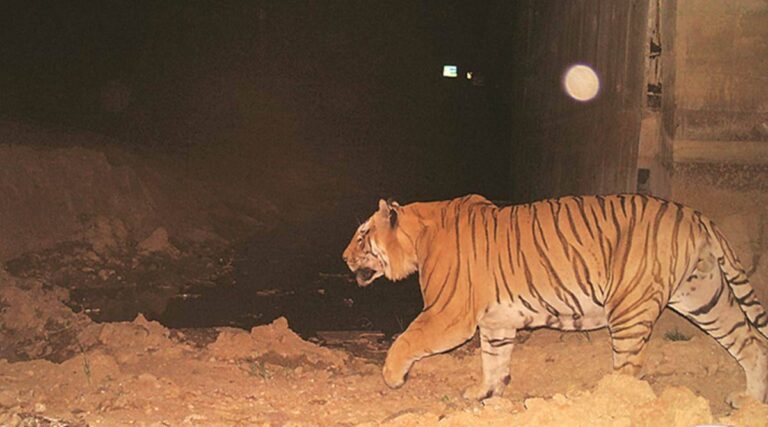
More than 5,450 wild animals, including 11 tigers, have been captured in the chamber using six underground road crossings, the first dedicated structures for crossing animals in the country, between March and December 2019, according to a report from the Institute of Life Wild of India (WII), Dehradun. According to the findings, the tiger, the spotted deer, the wild boar, the hare and the jungle cat are among the first species that are captured under the structures and captured regularly.

Tiger scientist Bilal Habib, who suggested mitigation measures, said: “The monitoring exercise has shown that these crossing structures are contributing to improving the permeability of the landscape. Such mitigation measures, if adopted, would help defragment the landscapes. fragmented. ”

The report, based on data from trap camera surveys from March to December 2019, states that 18 species of wild animals were found, excluding the rhesus macaque and gray langur, using these underpasses. According to the WII report, in addition to tigers and leopards, the most frequent users of these underpasses were spotted deer, wild boars and wild dogs. The other animals included jungle cat, mongoose, common palm civet, small Indian civet, Indian hare, rusty spotted cat and porcupine.

“As of December 31, 89 tiger crossings have been recorded under the mitigation structures. These crosses correspond to 11 individual tigers, who are also regular users of the underpasses, ”says the report. Along a 16.1 km length of the NH-7 that passes through forests adjacent to the Pench Tiger Reserve and intersecting the Pench-Navegaon-Nagzira Tiger Corridor, nine wildlife mitigation structures were constructed according to what was proposed in the WII-NTCA joint report in May 2015. “The results of the monitoring of mitigation measures in the NH-7 are very promising. We have reported 5,381 catches of 18 wild animal species from these underpasses, of the which was discovered that the jungle cat, the hare, the chital, the wild pig, the wild dog and the tiger use these structures more frequently, ”said tiger scientist Bilal Habib.

International Dog Day 2020: History, purpose and how to celebrate

International Dog Day is celebrated annually on August 26 to respect and celebrate every dog, no matter what breed they are, and to draw attention to the plight of canines and encourage adoption. Dogs are known as man’s best friend. They love their owners unconditionally.

History and purpose

WSON Team

International Dog Day was started as National Dog Day in the US in 2004 by pet and family lifestyle expert and animal rescue advocate Colleen Paige. She chose to observe the day on August 26 as it’s the date that her family adopted their first dog ‘Sheltie’ from an animal shelter home. https://wildstreakofnature.com/dogs-evolved-puppy-eyes-better-communicate-humans-study/The website of National Dog Day describes their mission as “to help galvanize the public to recognize the number of dogs that need to be rescued each year and acknowledges family dogs and dogs that work selflessly each day to save lives, keep us safe and bring comfort.” Also, National Dog Day celebrates dogs of all breeds.

How to celebrate International Dog Day

WSON Team

You can celebrate International Dog day by making a donation to shelter homes for canines. You can also volunteer with organisations that are working towards the cause of dogs. If you are planning to get a pet dog for yourself, then international Dog Day is symbolically the best day to do so. https://wildstreakofnature.com/dog-grooming-tips-winter-vs-summer/Also, when you are looking for a dog as a companion, you should “adopt, not shop”. You will promote breed discrimination by buying a dog and when you adopt a dog from a shelter home, another dog takes its place. So, you will actually save two lives.

World Elephant Day: Assam is Home to the World’s Oldest Asiatic Elephant?

In the tea gardens of Assam lives Bijuli Prasad, the oldest known Asiatic elephant in the world.

“Bijuli Prasad must be around 86 years old and is the oldest Asian elephant as per records,” Padma Shri awardee Dr. Kushal Konwar Sharma told G Plus. Dr. Konwar, known as the ‘Elephant Doctor’, has been treating Bijuli for over 25 years.

Bijuli Prasad belonged to the Magor Tea Estates of Assam and he was christened by Oliver Sahib from England who gave him this name.

In 1968, the Borgang Tea Company bought Bijuli. He was involved in uprooting old tea bushes and other works.

The elephant was put on salary, which was exceptional at the time, and from that salary, the wages for the mahout were cut, his food and medicine paid for and a pension started.

Bijuli stayed in Borgang post-retirement as well, as a member of the extended Magor Family.

Now, the old tusker lives a healthy life as a privileged member of the Bihali Tea Estate in Sonitpur district of Assam.

Bihali Tea estate had bought Bijuli from Borgang Tea Company in 2018. At Bihali Tea estate, the management has arranged for two keepers for Bijuli in the company’s payroll.

There are doctors to monitor his health and weight every week, along with proper meals three times a day.

Currently, Bijuli weighs around 400 kilograms and his health condition is stable despite his old age.

Normally, elephants live up to 50 years, while their maximum lifespan is generally estimated at 70.

Speaking to G Plus about Bijuli’s health, Dr Konwar said, “He has suffered from health problems earlier, but he has been treated well and is doing fine now.”

He added that Bijuli is unable to properly chew with his molar teeth and is thus fed boiled foods, grasses cut into small pieces, banana stem cut in small piece and rice among others.

Earlier, Dakshayani- the 88-year-old captive elephant in Kerala was considered to be the oldest in India and even Asia.

She died in Thiruvananthapuram, Kerala in 2019 after she became reluctant to eat anything during her last days.

86 endangered gharial hatchlings born along Bihar’s Gandak river

In a welcome development, as many as 86 gharial hatchlings were born on the banks of the Gandak river in Bihar’s Valmiki Tiger Reserve. Over the past few years numbers of the endangered reptile species have seen a positive rise, and the government has now stepped up efforts for their conservation.

In the Valmiki Tiger Reserve of ​​Bihar, the banks of the Gandak river have come alive with the sound of gharial hatchlings these days, as for the first time, a large number of gharials have been born here.

The banks of the Gandak river, which flows in the border of West Champaran district, witnessed the birth of 86 gharials this year. Since gharials, which belong to the same family as that of dinosaurs, are on the verge of extinction, the birth of such a large number of hatchlings is a welcome development.

There are currently hundreds of gharials in the Gandak River. Six years ago, a survey on revealed that only a dozen gharials remained in the Gandak River. Today however, the number has risen to 260. In view of their increasing number, the government has taken many meaningful efforts for their conservation.

Breeding period of gharials from April to June

Along with gharials, Gandak is also home to crocodiles and riverine dolphins. The breeding period of gharials starts from late March and April and continues till June. During May-June, the female digs a pit of 30 to 40 cm in the sand and lays 40 to 70 eggs. After about two months, the female removes the sand, and takes the hatchlings along with her to the river.

Farmers, fishermen being trained for conservation

In order to conserve the gharials, many people have been working at various levels. However, the biggest threat to the gharials remains the erosion of the banks of the Gandak river. Many hatchlings die in the process, and even unhatched eggs are washed away in the river due to erosion. Hence, the farmers and fishermen settled on the river are specially trained by the officials of the Wildlife Trust of India.

Further, they are also being trained to hatch the eggs of the gharials. The result of this training is what led to the birth of 86 gharials on the banks of the Gandak.

Preparations on to create safe sanctuary for reptiles

In view of the increasing number of crocodiles and gharials in the Narayani Gandak river, preparations are also underway to create a safe sanctuary area for the reptiles within the Valmiki Tiger Reserve by the Wildlife Trust of India and the Forest and Environment Department of the Bihar government.

System of crocodile-gharial breeding at only six spots

Throughout the world, there exist systems for the breeding of crocodiles and ghariala at only six places. The first gharial sanctuary in the country came up in Chambal, where the number of reptiles is around 1,600 to 1,800.

29% rise in Asiatic lion population in Sasan Gir

The number of Asiatic lions in the Gir forest region has increased by 29 per cent to 674, the Gujarat forest department said on Wednesday. The department carried out a population estimation exercise’ on the night of June 5 and 6 when there was full moon.

The exercise was undertaken as the five yearly census could not be carried out in May due to the coronavirus outbreak and lockdown, it said. As per the May 2015 census, there were 523 Asiatic lions in Gir, an increase of 27 per cent from 2010.

The “Poonam Avlokan (full-moon night estimation exercise)” showed that the lions’ population had reached 674, a 28.87 per cent increase, the official release said.
It was the highest growth rate recorded so far, it added.

The population of 674 comprised 161 males, 260 females, 116 sub-adult lions and 137 cubs, it said. The exercise also revealed that the area inhabited by lions has increased by 36 per cent from 22,000 sq km in 2015 to 30,000 sq km in 2020.

The exercise was carried out using ‘Direct Beat Verification’, also known as the block count method, and involved 1,400 personnel, it further said.

The teams relied on GPS data, identification marks and radio collar numbers to find out estimation of the population of the big cat at Gir, known as the last abode of Asiatic lions.

As per the officials, about two dozen lions died in the region in the last three months due to Babesiosis, a tick-borne disease. In October-November 2018, Canine Distemper Virus (CDV) had claimed the lives of 40 lions.

Earlier, Junagadh range Chief Conservator of Forest D T Vasavada had said that the estimation exercise was not a complete census.

“Lion census is carried out every five years in an extensive manner. Large number of central and state government officials, wildlife lovers, NGOs and members of National Board of Wildlife are involved in it. But due to lockdown we cannot call them now and a full-fledged census cannot be carried out,” he had said.