
Why unique finches keep their heads of many colors

An underlying selection mechanism prevents one color from dominating

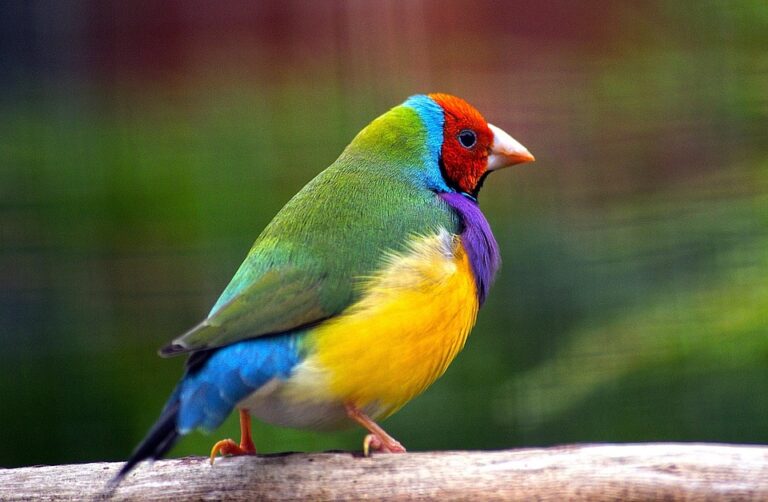
There appears to be an underlying selection mechanism at work among Gouldian Finches — a mechanism that allows this species to produce and maintain individuals with red heads, black heads, and yellow heads. Research by scientists from the the University of Sheffield in the United Kingdom, the Cornell Lab of Ornithology, and other institutions, reveals what this additional evolutionary process might be. Findings were published today in the journal Nature Communications.

“Most people have heard of natural selection,” says lead author Kang-Wook Kim at the University of Sheffield. “But ‘survival of the fittest’ cannot explain the color diversity we see in the Gouldian Finch. We demonstrate that there is another evolutionary process — balancing selection — that has maintained the black or red head color over thousands of generations.”

The yellow-headed type (actually more orange) is produced by a completely different mechanism that is not yet understood. Yellow-headed Gouldian Finches make up less than one percent of the wild population.

“Having distinct multiple color types — a polymorphism — maintained within a species for a long time is extremely rare,” explains co-author David Toews, who did this work as a postdoctoral researcher at the Cornell Lab and who is now at Pennsylvania State University. “Natural selection is typically thought of in a linear fashion — a mutation changes a trait which then confers some reproductive or survival advantage, which results in more offspring, and the trait eventually becomes the sole type in the population.”

Studies from Macquarie University in Australia have shown the red-headed finches have the apparent advantage. Female Gouldian Finches of all colors prefer the red-headed males, who also happen to be more dominant in the social hierarchy. So why hasn’t the black-headed type disappeared? It turns out there are disadvantages to having a red head, too, such as higher levels of stress hormones in competitive situations.

“If advantages are cancelled out by concurrent disadvantages, these two color types can be maintained — that’s balancing selection,” Toews says. “Red forms are not as common in the wild, so the counterbalancing pressure reduces the advantage of being red. That’s super cool!”

Teams from the University of Sheffield and the Cornell Lab independently zeroed in on a particular gene called follistatin which is found on the Gouldian Finch sex chromosome and regulates melanin to produce either red- or black-headed finches. Rather than competing, the two teams decided to join forces and share their data. For the yellow morph, a different gene, not located on the sex chromosome, is controlling the head pigmentation, but it hasn’t yet been found and it’s not clear what forces are allowing the yellow morph to persist in the wild.

In another twist, Toews and co-author Scott Taylor, at the University of Colorado-Boulder, have done previous research that revealed the genes likely governing the plumage differences between North American Blue-winged and Golden-winged Warblers — and one of those regions is in the same spot on the sex chromosome that differs among Gouldian Finches with different head colors.

“We didn’t expect we’d locate the exact genomic region that governs plumage differences in both the Gouldian Finch and the two warblers,” says Toews. “But now that we’ve done it, it opens up the possibility that the same region in other species may also be controlling plumage color.”
Climate change is a threat to dolphins’ survival

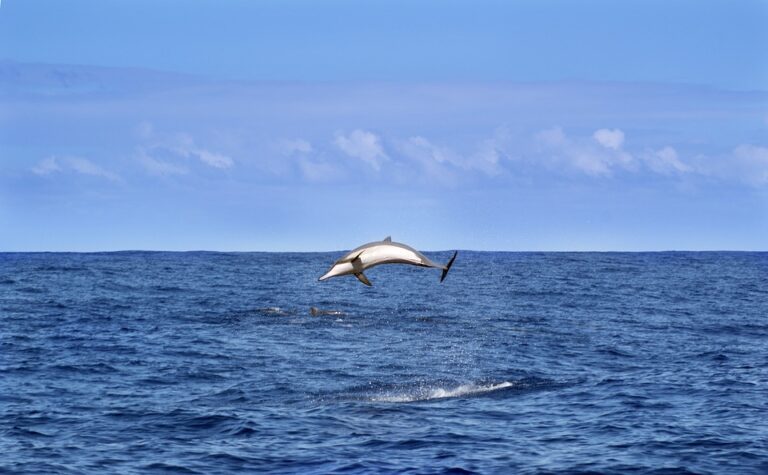
An unprecedented marine heatwave had long-lasting negative impacts on both survival and birth rates on the iconic dolphin population in Shark Bay, Western Australia. Researchers at UZH have now documented that climate change may have more far-reaching consequences for the conservation of marine mammals than previously thought.

Shark Bay in Western Australia in early 2011: A heatwave causes the water temperatures to rise to more than four degrees above the annual average. The extended period caused a substantial loss of seagrass, which drives the Shark Bay ecosystem, in this coastal area, a UNESCO world heritage site.

Researchers from UZH have now investigated how this environmental damage has affected survival and reproduction of dolphins. They used long-term data on hundreds of animals collected over a ten-year period from 2007 to 2017. Their analyses revealed that the dolphins’ survival rate had fallen by 12 percent following the heatwave of 2011. Moreover, female dolphins were giving birth to fewer calves — a phenomenon that lasted at least until 2017.

Negative influence of the heatwave is unprecedented

“The extent of the negative influence of the heatwave surprised us,” says Sonja Wild, former PhD candidate at the University of Leeds and first author of the study. “It is particularly unusual that the reproductive success of females appears to have not returned to normal levels, even after six years.” There are several possible explanations for this phenomenon, for instance neglect of calves, increased newborn mortality, delayed sexual maturity or a combination thereof, but researchers have not yet been able to investigate them in detail.

Tool-using dolphins are less affected

Interestingly, the heatwave did not have the same effect on all dolphin groups. Dolphins that use sponges as tools — a socially learned foraging technique that helps dolphins to locate food in deep water — were not as badly affected as those that do not use this technique. “Nevertheless, our work raises concerns that such sudden events might have quite negative long-term effects even in groups of marine mammals that are known to adapt usually well to novel environmental conditions,” says Sonja Wild.

Dire news for entire oceanic ecosystems?

The UZH researchers show in their study for the first time that marine heatwaves not only affect or-ganisms at lower levels of the food chain, but also might have considerable long-term consequences for the animals at the top, such as dolphins. “Marine heatwaves are likely to occur more frequently in the future due to climate change,” says study leader Michael Krützen, professor at the Department of Anthropology at UZH. “This is worrying not only for the long-term prospects of marine mammal populations, but also for the entire oceanic ecosystems.”

Sasan Gir: Asiatic Lion Lazing Around on a Tree Has Created Social Media

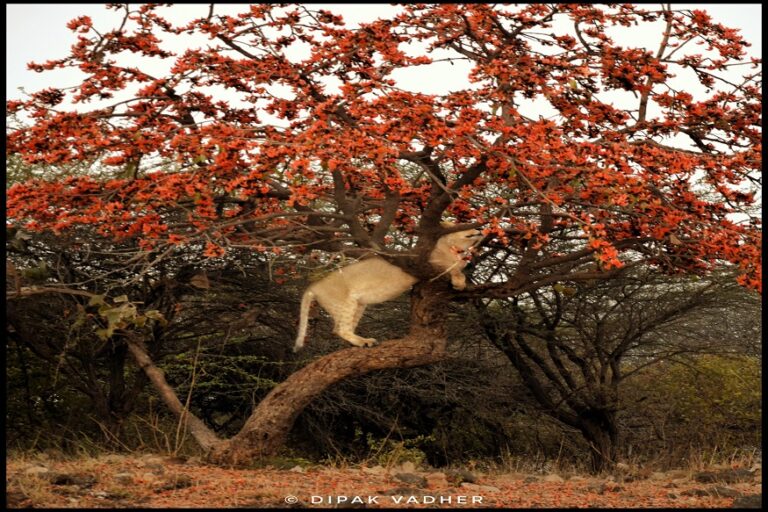
The rare moments of an Asiatic lion climbing on a ‘flame of the forests’ tree in Girnar Wildlife Sanctuary in Junagadh captured by the Forest Beat Guard has gone viral ever since it was shared by Deputy Conservator of Forests (Junagadh), Dr Sunil Kumar Berwal.

On Monday, Prime Minister Narendra Modi also shared the image with the caption, “Majestic Gir Lion, Lovely picture”.

“It was a moment of joy to capture the lion. I was on my routine patrol in the sanctuary when I came across a male lion climbing on a Flame of the Forests tree on March 5 at around 5:30 pm. It seemed as if he was posing for a photograph. I instantly took out my mobile phone and clicked the moment. It was literally a memory of a lifetime for me,’’ said 28-year-old Dipak Vadher, Forest Beat Guard.

In fact, Vadher said that lions are often found around this tree in the sanctuary and try to climb it. “Last year, I clicked some photos wherein a group of lions was trying to climb the same tree at the same spot but this year, it was a perfect photo,’’ he added.

Gir forest in Gujarat is the last abode of Asiatic lions in the world.

According to the last census of Asiatic lions, which was conducted in 2015, there were 523 lions in and around Gir wildlife Sanctuary in Saurashtra region of Gujarat. Out of the total 523 lions, 33 lions were reported from Girnar Wildlife Sanctuary.

“Dipak Vadher is a very sincere staff member and carries his own camera around during field duty. Some of his compositions are very good. ’’ Dr. Sunil Kumar Berwal, Deputy Conservator of Forests, Junagadh He also tweeted praises for Vadher, saying, “Dipak sees the forest in his own way as I have learnt from his photographs. Happy to see this picture of his being liked by all.”

Forest officials say that Girnar forests were once part of a major forest ecosystem comprising Gir and Girnar. Gradually, urbanisation and economic activities caused by major agricultural expansion and industrialisation have separated these two forests converting Girnar to an isolated compact patch of forest habitat of 178.8 square km.

Seven right whale calves spotted in Florida’s Atlantic waters

Seven rare right whale calves have been spotted so far this winter off Florida’s Atlantic coast.

Researchers say each new calf spotted this year is an encouraging sign for the critically endangered whales. No newborns were spotted during the last calving season, and just five calves were counted during the previous year.

But Katie Jackson of the Florida Fish and Wildlife Conservation Commission tells The Daytona Beach News-Journal that seven calves “still isn’t enough.” The wildlife biologist says right whales need to deliver 16 to 18 calves a year just to maintain their current population.

Scientists estimate only about 450 North Atlantic right whales remain.

Right whales typically migrate from the North Atlantic to give birth off the coasts of Georgia and Florida from December through March.

It’s official: Tiger in the state, Gujarat government has confirmed the presence

The Gujarat government has confirmed the presence of a tiger in the state, days after a man claimed he saw the big cat crossing a road in Mahisagar district.

State forest minister Ganpatsinh Vasava said on Tuesday that the carnivore was caught on cameras set up by the forest department in that area. “It has now been confirmed. A tiger in the age-group of 7 to 8 years has been seen in Mahisagar district,” Vasava told reporters in Gandhinagar.

Social Media

The striped animal was last seen in Gujarat in 1989. Subsequent surveys carried out every four years by the central government showed no presence of tiger in the state, he said. A local government school teacher had last week claimed that he saw a tiger crossing a road near Boriya village in Mahisagar, around 120 km from here, on February 6.

The teacher clicked the animal’s picture on his mobile phone and shared it with friends on social media platforms. The photo soon went viral and based on the teacher’s claim, the forest department set up several camera traps in that area.

Vasava said the tiger might have come to Gujarat from any of the neighbouring states of Rajasthan, Madhya Pradesh or Maharashtra, where the striped animals are found.
“The Madhya Pradesh government has said that a tiger has gone missing from Ujjain. It is possible that the tiger seen here can be from any of these neighbouring states which have tigers,” the minister stated.

He said the state government will now contact the National Tiger Conservation Authority (NTCA), which has the data of tigers across the country, to ascertain where the feline came from.

Social Media

The Wildlife Institute of India (WII) will also be involved to carry out a survey in the area to find out if this region is conducive for tigers, he said.

“We now agree that there is a tiger in Gujarat. We will study if the area could be developed for tigers. We are also seeking NTCA’s guidance,” he said.

Vasava said it was yet to be ascertained how long and where the lone tiger had been roaming in Gujarat.

“We are yet to ascertain if that area was the tiger’s permanent residence or whether it migrated from neighbouring states. It is certain that Gujarat is also a part of tiger’s natural corridor,” he said.

Principal Chief Conservator of Forests (Wildlife) Akshay Saxena said evidences like pugmarks and scats, as well as hair and scratch marks on a tree had to some extent confirmed the tiger’s presence in the region.

“Later, camera traps were set up and we have now got visual evidence of a tiger in the area. It is not necessary that we will find the tiger in the same area, so we will continue to keep a watch,” he said.