Vehicle Speed Limit Restricted In Assam’s Kaziranga National Park

Assam Kaziranga National Park: Six sensor-based cameras have been installed in nine designated animal corridors of the park, stretching from Rengali to Borjuri, in Assam to detect the speed of vehicles.

The Kaziranga National Park authorities have fixed a maximum speed limit of 40 km per hour for vehicles in the sanctuary with an objective to avoid wildlife deaths due to accidents and allow free movement of animals, an official said on Thursday.

Six sensor-based cameras have been installed in nine designated animal corridors of the park, stretching from Rengali to Borjuri, in Assam to detect the speed of vehicles, he said.

The cameras have been installed along the National Highway 37 that passes along the southern boundaries of the Kaziranga National Park, the home of the famous one-horned rhinos, and these will become operational from Friday, Eastern Assam Wildlife Division’s DFO Ramesh Gogoi said.

The cameras are equipped with automatic number plate recognizing with radar for the determination of speed, the divisional forest officer said.

The authorities used to regulate vehicle speed limit during floods in Assam as animals come near the NH 37 in search of dry land with many crossing the road to reach highlands.

Speeding vehicles on the highway have claimed the lives of several animals, particularly when the park is flooded and the animals cross the road to reach the highlands.

As per the orders of the National Green Tribunal (NGT), owners of vehicles plying above the 40-km per hour speed limit will be penalized.

“Overspeeding vehicles in the stretch will also be booked for violation of a provision of the Code of Criminal Procedure,” the official said.

Each vehicle, which is booked, particularly for overspeeding and killing or injuring animals, would be fined an environmental compensation of ₹ 5,000 per incident, over and above the amount to be paid for an offense under the Motor Vehicles Act.

“Under these circumstances, all commuters are mandated to abide by the maximum speed limit of 40 km per hour in all animal corridors of Kaziranga National Park in the interest of the safety of wild animals,” Mr. Gogoi added.

Check out these wildlife sanctuaries in India for an unforgettable experience!

0

With summer at its peak, the weather across the country encourages wildlife to come out into the open. The tigers, the lions, and the other rare and exotic species all come out of their shelters to bask in the warm sunray. The different variety of birds chirping in the blue sky above, the animals embracing the warm in the open, the light summer breeze that blows, etc., all this sure makes for a wonderful and exhilarating experience visiting wildlife during this season.

Top Wildlife Sanctuaries To Visit In Summer

These wildlife sanctuaries in India act as a sensuous treat for people from all walks of life and encourage many wildlife photographers and nature lovers to make the most of their surroundings.

1. Jim Corbett Wildlife Park

WSON Team

Best known for the Bengal tigers found here, one can also find wild elephants, serow, goral, etc. roaming around the park along with various other animal and bird species. Jim Corbett is known to be Asia’s first National Park, established in the year 1936. It is also one of the best places to visit in India for nature lovers. For best spotting, one should visit here during the months of March to May.

2. Ranthambore Wildlife Park

WSON Team

An ideal park that boasts of a number of tigers, this national park, located in Rajasthan, is the ideal fit for all the wildlife photographers and nature enthusiasts. It was once said to be the hunting grounds of the great Maharajas, so one can also find historical ruins, forts and temples around and inside the park, making it an ideal place for wildlife photographers and history buffs.

3. Pench National Park

WSON Team

Home to a good number of leopards and tigers, this park located at the border of Madhya Pradesh and Maharashtra also houses over 285 beautiful migratory and resident birds. During summers, tourists are lucky to spot some wild boars, nilgai etc. The vast expanse with varied topography attracts a lot of foreign tourists as well. The national park has served as an inspiration behind the famous Jungle Book by Rudyard Kipling. Best time to visit this park is from March to June.

4. Tadoba Tiger Reserve

WSON Team

This reserve has gradually become famous for top-class tiger sightings over the last couple of years. It presents a wonderful landscape, surrounded by lakes, forests, and hills. This park remains open throughout the year, unlike many other wildlife sanctuaries. But the best time for spotting tigers is from March to May. One can also find barking deer, gaur, hyenas, and leopards among many other animals here.

5. Kanha National Park

WSON Team

This national park is home to black panthers, bears, pythons, elephants, and the tiger. The flat landscaping makes it easy for viewers to spot animals, where one can spot deer prancing on one side, and peacocks playing on the other while enjoying the serene nature at the same time. To spot the majestic cats, one should visit during the months of March- June.

The peak summer months enrich the overall experience as temperatures in most national parks across India are on a rise during summer, thereby, allowing a large number of wildlife enthusiasts to make the most of their surroundings. Plan your next vacation to one of these five national parks which unleash a wide range of attractions once the mercury rises.

Everything You Need To Know About Rock Python, Learn more

0

It’s huge, it’s beautiful and though it’s nonvenomous, the African rock python is a reptile to be respected. Who needs venom when you have coils that can crush the life out of a grown goat and jaws that can unhinge to swallow it whole? Read on to learn more about this amazing beast.

Incredible Rock Python Facts!

Here are five amazing facts about these snakes.

  • These jumbo-sized pythons have been known to weigh over 200 pounds. Most weigh about 121 pounds.
  • Pythons from central and western Africa tend to have brighter colors than those from north, south, and east Africa.
  • The one time adult rock pythons are in danger from natural predators such as hyenas is after they’ve had a large meal and have to stay in one place to digest.
  • The Luo people, who live in Kenya, worship unaggressive rock pythons as harbingers of fertility.
  • Unlike most snakes, the rock python has two lungs that work. Finding two working lungs helps in the identification of a python.

    Where To Find Rock Pythons

    Rock pythons are found in many locations in sub-Saharan Africa, as long as it is not too dry, as it would be in a desert, or too cold as it would be high on a mountain. Their preferred habitats are open savannas and moist evergreen forests near bodies of fresh water, and they get their name because they are often found on outcroppings.

    Scientific Name

    The African rock python’s scientific name is Python sebaePython is taken from the Greek nake for the serpent-like monster killed by the god ApolloSebae comes from Albertus Seba, a Dutch zoologist. There are two subspecies of P. sebae. They are the following:

    • P. subae subae
    • P. subae natalensis

      The Different Types of Rock Python

      The two African rock python subspecies are the northern African rock python, P. sebae sebae which is found in western and central Africa, and the southern African rock python which is found in scattered locations around southern Africa, from Namibia to the coasts of Tanzania and Mozambique. The southern python is the smaller and less colorful of the two.

      The African rock python and its subspecies aren’t the only types of these snakes. Python molurus is also known as the Indian or Asian rock python. It is smaller in size than the African rock python and lives in IndiaPakistanBhutanBangladesh, and southern Nepal, and some believe there are pythons in Myanmar. The Indian rock python also differs from the African rock python in that it is timid.

      Population and Conservation Status 

      Though the number of wild African rock pythons hasn’t been evaluated, the reptile’s conservation status is near threatened. This is largely due to poaching for its meat and its hide. The snake is also under some pressure from habitat loss.

      Appearance and Description 

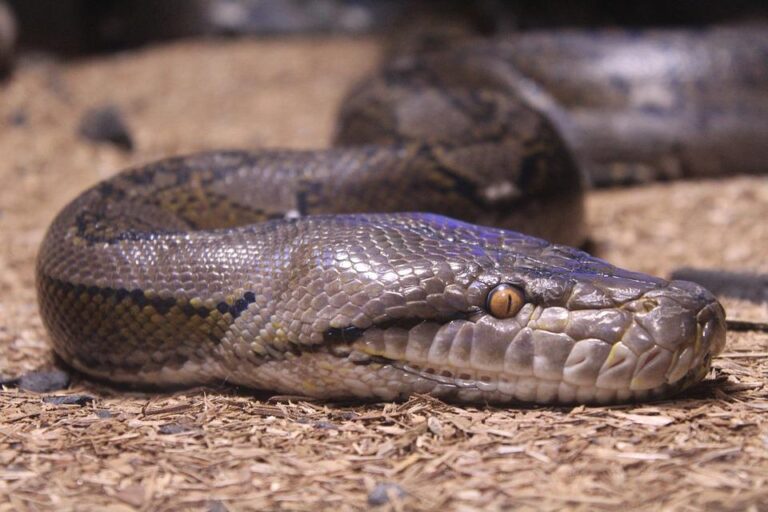
      An adult P. sebae is a huge animal, ranging from nearly 10 feet to over 25 feet in length, and females are bigger than males. It is not just long but has a robust body that can contribute to it weighing close to 200 pounds or more. It has a small, v-shaped head with a spearhead-shaped pattern on top. The body is grayish-brown, grayish-green, or yellowish with darker blotches edged in white, and the scales are smooth. The belly of the snake is white and speckled with black.

      These beautiful patterns and colors make the snake vulnerable to hunters who want its hide for leather. On closer examination, a person might discover pelvic spurs. These are what is left of the hind legs snakes got rid of eons ago. The presence of pelvic spurs is another aid in the identification of a python.

      Rock Python vs Burmese Python

      Differentiating the rock and Burmese pythons can be challenging because they do look somewhat alike. One means of identification of the Burmese python is that its hide is made of brown blotches edged in black. The blotches on the rock python are edged in white and are sometimes not as distinct and merge together more than the blotches of the other python. The Burmese python, P. bivittatus is also smaller in size than P. sebae and rarely gets over 18 feet long. Though it is considered bad-tempered, the Burmese python is still not as aggressive as the rock python. Though both python mothers incubate and guard their eggs, the Burmese python “shivers” to produce heat for her eggs, while the rock python doesn’t

      Venom: How Dangerous Are They?

      These snakes are nonvenomous, but they can grow to be so big and powerful that it’s not safe for an inexperienced person to be around them. Even experienced people are sometimes attacked.

      Behavior and Humans

      As with most types of snakes, P. subae is solitary save for the mating season. Despite their great size, they can climb trees well. They’re also good swimmers and sometimes have fish as part of their diet. They are mostly nocturnal predators, though they might bask in the sun to warm up during the day. Younger snakes are more active at sunup and just after sundown and seek shelter in a tree cavity or under a rock outcropping.

      These snakes are ready to breed when they’re between three and five years old, which is when females are about 8.86 feet long, and males are about 5.9 feet long. They have a lifespan as long as 30 years in captivity.

      The snakes mate in the late fall to late winter or early spring. Both males and females stop eating at this time, and the female won’t eat again until her eggs hatch. She’ll lay them about three months after mating in an abandoned burrow, a cave, a hollow tree, or a termite mound. A clutch can contain from 20 to as many as 100 surprisingly large, hard-shelled eggs. She’ll guard them until they hatch, which is 65 to 80 days after they were laid. Hatchlings are independent at birth. Some mothers take no more care of their babies, while others guard them for as long as two weeks. This is very unusual behavior for a snake.

      Though big rock pythons are capable of killing humans, this is very rare. Humans, however, frequently kill rock pythons for their meat and their hides. Some people try to keep these animals as pets. Juvenile pythons are beneficial for they eat rats and other pests before they move on to larger fares as they grow.

What Are Mammals: Explained, The 10 Characteristics You Need to Know

The official mammal class is Mammalia. Types of animals that are mammals include warm-blooded vertebrates that have hair or fur and whose babies drink milk. Unlike other animal types like birds and insects, all mammal babies drink milk that comes from their mother’s bodies. This is one of the key ways to know if an animal is a mammal.

What Are Mammals? – The 10 Characteristics You Need to Know

Mammals have many other unique characteristics compared to other animal types. You can use some of these key mammal markers to identify whether an animal is a mammal:

  1. Warm-blooded vertebrates – Mammals are endothermic, meaning they have a constant body temperature. Mammals are also vertebrates, meaning they have a backbone
  2. Red Blood Cells Without Nucleus – Mammals have adult (mature) red blood cells, known as erythrocytes, that lack a nucleus. This is unique compared to other vertebrates.
  3. Has hair or fur – Mammals commonly have hair or fur. Though hair and fur are chemically similar and both made of keratin, they are characteristically different. Hair is normally longer and thinner than fur, while fur is usually shorter and coarser. Both serve as insulators for animals.
  4. Contains a Malleus, Incus, and stapes – The Malleus is a small bone in the middle ear that is shaped like a hammer. It connects the inner surface of the eardrum with the incus. Given its shape, the name is derived from the Latin word for ‘mallet’. The incus is shaped like an anvil and serves a similar function, vibrating to transmit sound. The stapes is a stirrup-shaped bone. Together they form the ‘hammer, anvil, and stirrup’, three of the smallest bones in the human body. The stapes is the actual smallest.
  5. Able to produce milk – Mammals contain mammary glands. These glands give them the ability to produce milk to feed their offspring.
  6. A diaphragm – Mammals have a diaphragm sitting between their heart and lungs
  7. Hinged Lower Jaw Connected To Skull – Mammals have a hinged lower jaw that connects directly to the skull. By comparison, all vertebrates connect through another bone known as the quadrate. This mammal articulation allows them to more easily grasp and chew food, as well as chew sideways.
  8. Left aortic arch – In mammals, the fourth (left) pharyngeal artery is most commonly the arch of the aorta. This differs compared to other animal types. There can be rare cases where mammals have a right aortic arch variant.
  9. Neocortex – Mammals commonly have a neocortex in their brain. This specialized region allows them to both hear and see.
  10. Live Birth6 – Mammals are viviparous, meaning they give birth to live babies. There are three different types of mammal birth. Monotremes, marsupial, and placental mammals are discussed further below.

    Mammal Exceptions

    There are some exceptions to the mammal criteria. Whales are mammals but they are born without hair or fur as it has typically gone after the fetal stage. Yes, that means the blue whale is in fact a mammal!

    Monotremes like the duck-billed platypus and echidnas are a whole category of egg-laying mammals that are the only mammals that do NOT give birth to live young. Instead, animals like the platypus and echidnas actually lay eggs.

    The Three Different Types of Mammal Births

    Monotremes

    A rare and unusual category of mammal birth is where the animal lays eggs. There are only five known monotremes mammals on the planet, with the platypus and echidna are being the most well known.

    Marsupial

    Marsupial mammals give birth to their young before they are fully developed. The babies then complete their growth outside of the mother but in a ‘pouch’. Well-known marsupial examples include kangaroos, opossums, and wombats.

    Placental Mammals

    Members of this birth group have a birth procedure containing a placenta. The presence of a placenta transfers important nutrients between the mother and offspring, helping protect the young and ensure a well-developed birth. Placental births are the most common among all mammals with examples including dogs, horses, cats, and humans.

Learn All About Black Mamba Vs King Cobra: What’s The Difference?

0

You would be hard-pressed to find two snakes that evoke more fear than the black mamba and the king cobra.

Both species are so venomous that they can easily kill a human, and, they both grow to over ten feet in length. But, when it comes to the differentiation between the black mamba vs king cobra, how do you tell the difference?

In this article, we’ll learn the exact differences between black mambas and king cobras. To do this, we’ll go over each species’ size, appearance, location and habitat, behavior, diet, and lifespan. By the end, you’ll be able to tell black mambas from king cobras, and you’ll know exactly what makes each species unique.

Keep reading to learn more about black mambas and king cobras.

Comparing Black Mamba vs King Cobra

Black Mamba King Cobra
Size 6-14 feet long; 5-10 pounds 10-18 feet long; 15-20 pounds
Appearance Gray to dark brown body with a pale belly and black inside of the mouth. Has a small hood that flattens when threatened Ranges from black or dark brown to yellow or green. Babies are black with white markings
Location and Habitat Sub-Saharan Africa; lives in rocky hillsides, savannahs, grasslands, and woodlands. Prefers to stay near freshwater Southeastern Asia; frequents mangrove swamps, forests, bamboo forests, and the edges of farmlands
Behavior Non-aggressive, but capable of biting multiple times when threatened Only bites when threatened; females guard eggs until hatching
Lifespan 10-15 years 15-20 years


Key Differences Between Black Mamba vs King Cobra

Black mambas are smaller than king cobras by several feet. The king cobra lives in India and Southeastern Asia, while the black mamba makes its home in sub-Saharan Africa. Both species have extremely potent venom, and both are responsible for many human deaths every year. King cobras have impressive hoods, while black mambas have no hood.

Let’s take an in-depth look at the key differences between the black mamba vs king cobra.

Black Mamba vs King Cobra: Size and Weight

When it comes to the black mamba vs king cobra, length is everything. Both species are exceptionally long snakes, but only one can be the longest venomous snake in the world. That’s the king cobra. A true monster among snakes, it can grow to nearly twenty feet long. The black mamba is no small fry either, though it’s not quite as impressive as the king cobra. Black mambas can reach up to 14 feet in length.

The king cobra isn’t just longer than the black mamba, it’s heavier too. Black mambas generally weigh less than ten pounds, while the king cobra can weigh up to twenty pounds. King cobras are heavy snakes, much heavier than the black mamba.

Black Mamba vs King Cobra: Location and Habitat

Black mambas and king cobras live on entirely different continents. The black mamba lives in parts of south and east Africa in sub-Saharan areas. In contrast, the king cobra lives in India, China, Indonesia, and the Philippines.

Locally, the black mamba vs king cobra lives in distinct habitats. Black mambas prefer woodlands, hilly areas, savannas, and grasslands. They don’t like to stray too far from freshwater, and at night they prefer sleeping in hollow trees or empty burrows. King cobras stick mostly to forested areas, mangrove swamps, bamboo forests, and the edges of agricultural zones. King cobras spend much of their time in trees and bushes.

Black Mamba vs King Cobra: Appearance

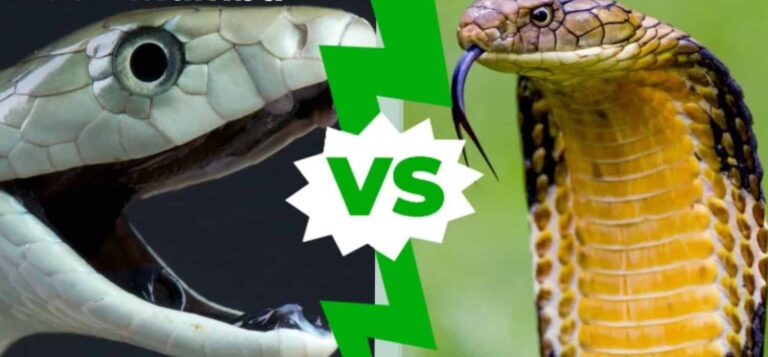
When it comes to the appearance of the black mamba vs king cobra, the biggest difference is in the king cobra’s hood. Black mambas lack a large hood, what they do have is a pitch-black mouth. The king cobra has one of the largest hoods of all snakes, while black mambas sport only a small, narrow hood.

In terms of coloring, the only part of the black mamba that’s actually black is its mouth. The rest of the black mambas’ body ranges from gray to brown, with a light belly. King cobras tend to be darker brown or black, with white or yellow crossbars, and markings on the undersides of their hoods.

Black Mamba vs King Cobra: Behavior

Despite their differences, black mambas and king cobras share many behaviors. Both species lay eggs, rather than give birth to live young. Female black mambas lay their eggs in underground burrows, and female king cobras actually build nests for their eggs.

When it comes to the black mamba vs king cobra diets, both hunt rodents, and small mammals, as well as other snakes.

Black Mamba vs King Cobra: Lifespan

King cobras have been known to live up to 20 years in the wild, while black mambas live up to 15 years. In captivity, they may live even longer.