Although you’re more likely to get killed by lightning (or even cows who kill about 20 people yearly), the fear of death by a shark attack is universal. Fear of the most aggressive sharks in the world became universal after films like Jaws and The Meg became pop culture hits.
But the subject can be looked at as… Is the glass half-full or half-empty? On the one hand, Sharks have only killed an American once every 1.7 years. On the other: There are around 500 species of sharks, with more being discovered, but only a small portion of those are seen as highly aggressive. With that in mind here are 7 of the most aggressive shark species in the world.
Great White Shark
WSON Team
Great white sharks are the most aggressive sharks in the world has recorded 333 attacks on humans, with 52 of them being fatal.
The inclusion of this particular species probably comes as no surprise since movies, particularly Jaws, and television shows are quick to show their aggression. And they would be partly right. Worldwide, the Great White is responsible for about ⅓ to ½ of the 100-plus shark attacks per year making them the number one of their species that do so. Although almost all of those are not fatal, it’s still a sobering statistic.
The fact is, when a great white shark spots a swimmer or surfer from below, they may not be able to differentiate them from their favorite meal: seals.
Human beings aren’t what White Sharks normally stalk. They are carnivores though, able to swim up to around 25 mph, and eat mostly:
Sea turtles
Sea lions
Seal
Porpoises
Dolphins
The largest Great Whites are around 20-feet long and weigh between 1,500 and 4,000 pounds. The largest ever recorded great white is estimated to weigh 5,000 pounds!
Tiger Sharks
a-z-animals.com
A tiger shark gets its name from the dark stripes on its body when it’s younger than fade with maturity. Their size range is from 10-14 feet with females being larger than males. Large female tiger sharks can weigh 2,000+ pounds.
It is second in line, behind the great white, in recorded human fatalities having attacked 131 humans which includes 34 fatalities.
Tiger sharks feed mostly at night, close to shore, and eat the most varied range of prey of all sharks including:
Fish
Birds
Seal
Turtles
Dolphins
Sea snakes
Squid
Crustaceans
They could be called an ocean trash can in that tiger sharks eat almost anything, living or not. The tiger shark’s teeth are unusually serrated and most are pointed in different directions. This weapon gives it the upper hand with prey since it can easily slice through shells and bones. Like most sharks, their rows of teeth are replaced throughout its life.
Bull Sharks
shutterstock_111617900
In the United States, bull sharks are found off the East Coast and in the Gulf of Mexico. They’re extremely aggressive and can also be found in freshwater which has given them more access to humans.
Male and female Bull Sharks have quite the difference in size with males reaching about seven feet in length and females growing up to 11 feet. Adults can weigh from 200 to 500 pounds.
Adult bull sharks have no natural predators. While they have been observed feeding on plants and algae, the vast majority of what bull sharks eat consists of meat. Their diet includes:
The jaw strength of bull sharks is formidable having a 6,000-newton bite force or around 1,300 lbs. of force. (Humans have from 247 to 292 lbs. of bite force.) They don’t have an appetite for humans but if they do attack, they normally break away after realizing it’s not their normal prey.
With that being said, bull shark aggression has resulted in 117 humans being attacked with 25 of them being fatal.
Blacktip Shark
WSON Team
These sharks can be found year-round in the Gulf of Mexico and are also in the waters from Virginia through Florida as well as many other places in the world. Their pectoral, dorsal, and tail fins are black-tipped. They’re also one of the shark species that spin out of the water while feeding.
Their diet includes:
Bony fish
Smaller sharks
Squid
Stingrays and skates
Shrimp
Crabs
Blacktip sharks prefer shallow, clear water. They’re generally around 5 feet long and their average weight is 55 pounds. Their smaller size makes them no less formidable.
If they feel threatened, they will respond by:
A. Swimming straight towards the threat
B. Abruptly turning away and rolling side-to-side
C. Lowers its pectoral fins
D. Tilts its head and tail upwards
E. Make sideways biting motions
The entire behavioral show takes around 30 seconds. Although they don’t pose a significant threat to humans, they are on record with 41 human attacks and no fatalities. The blacktip reef shark is also listed with 14 human attacks and no fatalities.
Sand Shark
a-z-animals.com
Sand tiger sharks are also known as gray nurse sharks and ragged-tooth sharks. They are often spotted near the ocean floor. Their name is derived from the fact that they migrate towards shorelines and are often seen by surfers. They live in warm waters throughout the world. In total, there are three species of sand sharks that also include smalltooth sand tigers and bigeye sand tigers. The largest smalltooth sand tigers are about 15 feet long and weigh around 600 lbs.
Their hunting habits arequite unique. Sand tiger sharks collect air in their stomach from above the surface and become buoyant. This buoyancy allows sand tiger sharks to sit virtually completely still and approach prey undetected.
Similar to other shark species, they can detect electrical currents produced by prey with electroreceptors in their snouts. (Sharks’ smelling abilities are ranked in the top ten of the entire animal kingdom, including those on water and land.)
Sand tiger sharks are also a night-hunter and during the day they’re basically inactive. Their diet consists of mostly small fish but they also eat crustaceans and squid as well. Although humans aren’t their normal prey, sand tiger sharks are on record for having attacked 36 humans with no fatalities.
Great Hammerhead Shark
shutterstock_1021602427
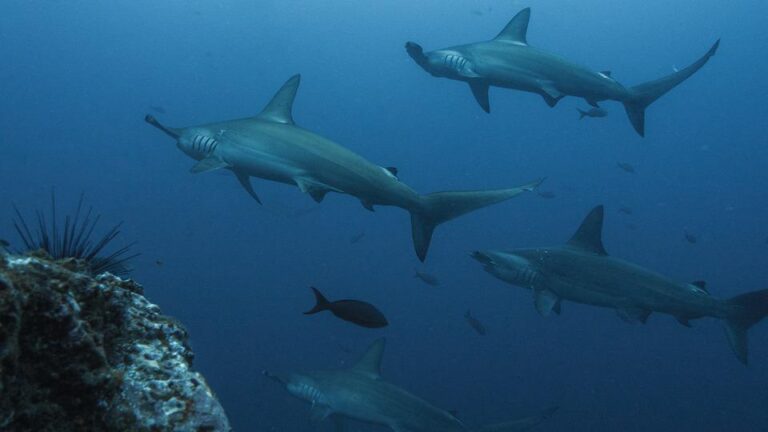
There are nine different species of hammerhead shark in the world with the largest being the great hammerhead. They’re known for their small mouths, eyes on the sides of their head, and of course the shape of their heads that resemble a hammer.
Great hammerheads inhabit the waters of the Gulf of Mexico and the Atlantic coasts of Florida. Their average length is 15 ft. but they can reach up to 20 ft. and they weigh over 500 pounds. Much heavier ones at double the weight have been documented, but are rare.
As great hammerheads hunt, they move their heads back and forth to scan the ocean floor for the electrical signals given off by stingrays — a favorite prey — that may be buried. The stingray’s venom seems to have no effect on the species.
After they incapacitate their prey with the strength of their blow, they will pin them to the ocean floor with their heads to continue feeding. The adults’ are rarely hunted, but their main predator is the killer whale.
Although this species is labeled as the most dangerous of the nine hammerheads, humans aren’t their normal prey. There have been human attacks, however. All 16 the attacks were non-fatal, but generally great hammerheads are just highly curious of divers like many other shark species.
Note: The shark attack statistics accompanying each of these 7 most aggressive sharks are from the ISAF (International Shark Attack File) which is the world’s only scientifically documented, comprehensive database of all known shark attacks. Recordings began in 1958.
Hopefully, you’ve learned something new about the 7 most aggressive sharks. You could say sharks aren’t a real danger to humans. But the people who have been attacked by one may think differently. With their torpedo-like bodies and seemingly emotionless eyes, it’s easy to see why people fear these creatures.
So what can we do? Our best bet is to have a healthy respect for sharks and behave cautiously when we’re in their world which would serve us well.
According to forest officials, they received information early morning about peacock carcasses lying in the land near Tamil Nadu’s Perundurai.
Seven peacocks were found dead in private land near Tamil Nadu’s Perundurai on Wednesday, officials said.
According to forest officials, they received information early morning about peacock carcasses lying in the land at Seenapuram near Perundurai.
They said the land, belonging to Kannan, has some crops and some persons crossing the area noticed that the birds were lying dead there.
Officials are conducting an investigation and also interrogating the landowner. Peacocks are protected under Schedule I of the Wildlife Protection Act, 1972. It is the national bird of India. The forest officials said some poultry were found dead in the same land a few days ago.
At least hundreds of so-far unidentified species of mammals are hiding in plain sight around the world, a new study suggests.
Researchers found that most of these hidden mammals are small-bodied, many of them bats, rodents, shrews, and moles.
These unknown mammals are hidden in plain sight partly because most are small and look so much like known animals that biologists have not been able to recognize they are actually a different species, said study co-author Bryan Carstens, a professor of evolution, ecology, and organismal biology at The Ohio State University.
“Small, subtle differences in appearance are harder to notice when you’re looking at a tiny animal that weighs 10 grams than when you’re looking at something that is human-sized,” Carstens said.
“You can’t tell they are different species unless you do a genetic analysis.”
The study was published today (March 28, 2022) in the Proceedings of the National Academy of Sciences.
The team, led by Ohio State graduate student Danielle Parsons, used a supercomputer and machine-learning techniques to analyze millions of publicly available gene sequences from 4,310 mammal species, as well as data on where the animals live, their environment, life history and other relevant information.
This allowed them to build a predictive model to identify the taxa of mammals that are likely to contain hidden species.
“Based on our analysis, a conservative estimate would be that there are hundreds of species of mammals worldwide that have yet to be identified,” Carstens said.
That finding, in itself, would not be surprising to biologists, he said. Only an estimated 1 to 10% of Earth’s species have been formally described by researchers.
“What we did that was new was predict where these new species are most likely to be found,” Carstens said.
Results showed unidentified species are most likely to be found in the families of small-bodied animals, such as bats and rodents.
The researchers’ model also predicted hidden species would most likely be found in species that have wider geographic ranges with higher variability in temperature and precipitation.
Many of the hidden species are also likely to occur in tropical rain forests, which is not surprising because that’s where most mammal species occur.
But many unidentified species are also likely living here in the United States, Carstens said. His lab has identified some of them. For example, in 2018, Carstens and his then-graduate student Ariadna Morales published a paper showing that the little brown bat, found in much of North America, is actually five different species.
That study also showed a key reason why it is important to identify new species. One of the newly delimited bats had a very narrow range where it lived, just around the Great Basin in Nevada — making its protection especially critical.
“That knowledge is important to people who are doing conservation work. We can’t protect a species if we don’t know that it exists. As soon as we name something as a species, that matters in a lot of legal and other ways,” Carstens said.
Based on the results of this study, Carstens estimates that somewhere near 80% of mammal species worldwide have been identified.
“The shocking thing is that mammals are very well described compared to beetles or ants or other types of animals,” he said.
“We know a lot more about mammals than many other animals because they tend to be larger and are more closely related to humans, which makes them more interesting to us.”
The study was supported by the National Science Foundation and the Ohio Supercomputer Center. Other co-authors were Tara Pelletier, assistant professor of biology at Radford University; and Jamin Wieringa and Drew Duckett, graduate students at Ohio State.
House Sparrow- deserve a house arrest or high flight?
World Sparrow Day That dainty little birdie is losing its chirp in your backyard. It’s time to rejuvenate your surroundings by rejoicing their close proximity to your dwellings.
Jayant Sojitra, WSON Team
The house sparrow (Passer domesticus) is truly one of those birds that will take you back to the memory lane of childhood. Their nests adorned every house and public place back then. Irony much in 202? Surviving on food grains and tiny worms, these little birds needed no distinct treatment. Many bird watchers and ornithologists recall with fondness how the house sparrow gave flight to their passion for observing birds. The association with sparrows is centuries old and is well mentioned in folklore and songs from time immemorial.
Jayant Sojitra, WSON Team
Unfortunately, the house sparrow is now a disappearing species. But like all other plants and animals which were once abundant and are now facing an uncertain future, their numbers are also declining across their natural range. The reasons behind it are multiple but however, the noticeable disappearance is still a big mystery. Worldsparrowday.org says- A leading newspaper in the United Kingdom, a country that has witnessed one of the biggest declines of the house sparrow population in recent times – declared a cash prize to anyone who could solve the mystery. Needless to add, the reward lies unclaimed.
Increasing pollution from mobile phone towers, deforestation, global warming, non-vegetarianism, all of it add to the decline in the number of species. It’s time you glance through a few quick facts of the beauty we discussed above-
Jayant Sojitra, WSON Team
Sparrows can survive between 4 and 5 years in the wild.
The oldest sparrow recorded to date is known to live for 15 years and 9 months!
House Sparrows love to play with dust and soil. They spoil themselves in the dust as if trying to have a bath with it.
Sparrows raise three nests of 3-5 eggs. Both males and females help to incubate the eggs for 12-15 days. The fledglings usually fly out after 15 days.
Once found in huge numbers across the world, the small bird is slowly making its way to the endangered list.
This World Sparrow Day, let’s all pledge to switch to a better tomorrow; all for the nature around us.
From the east of India, all through to the north of Australia, one fearsome, cold-blooded predator stalks the coasts.
This hypercarnivore will contend with any that enters its watery domain, from birds to men to sharks, and almost always win that fight. Fossil evidence shows that this species has been plying its bloody trade for almost 5 million years, remaining virtually unchanged, a testament to just how efficient a killing machine it is. Looking at in the eye is the closest thing we have to stare down a carnivorous dinosaur.
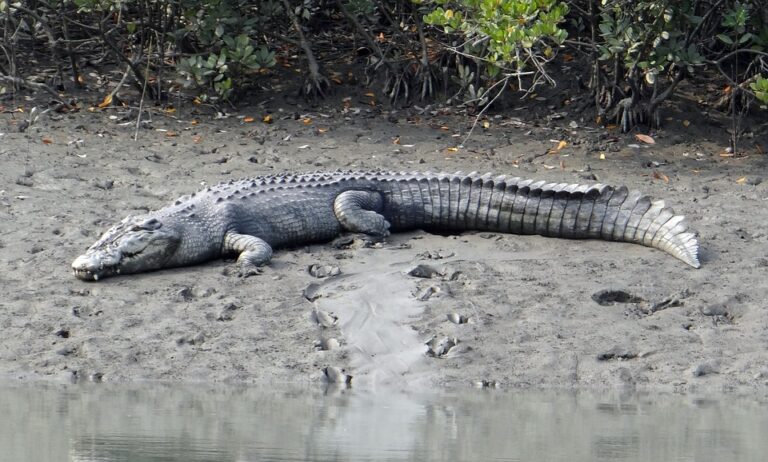
This animal is the saltwater crocodile (Crocodylus porosus). It has the distinction of being the single largest reptile alive on the planet today, and one of the oldest species to still walk the Earth.
Predatory legacy
WSON Team
The earliest fossil evidence we have of this species dates back to the Pliocene Epoch, which spanned from 5.3 million to 2.6 million years ago.
Crocodiles began truly coming into their own some 55 million years ago, evolving into their own species in the shape we know them today. They have remained almost unchanged since, a testament to how well-adapted they are to their environments, and the sheer efficiency with which they hunt.
This makes the crocodile family, and the saltwater crocodile as one of its members, one of the oldest lineages alive on the planet today.
The saltwater crocodile
WSON Team
With adult males reaching up to 6 or 7 meters (around 20 to 23 ft) in length, this species is the largest reptile alive today. Females are smaller than males, generally not exceeding 3 meters in length (10 ft); 2.5 meters is considered large for these ladies.
The saltwater crocodile will grow up to its maximum size and then start increasing in bulk. The weight of these animals generally increases cubically (by a power of 3) as they age; an individual at 6 m long will weigh over twice as much as one at 5 m. All in all, they tend to be noticeably broader and more heavy-set than other crocodiles.
That being said, they are quite small as juveniles. Freshly-hatched crocs measure about 28 cm (11 in) in length and weigh an average of only 71 g — less than an average bag of chips.
Saltwater crocodiles have large heads, with a surprisingly wide snout compared to other species of a croc. Their snout is usually twice as long overall as they are wide at the base. A pair of ridges adorn the animal’s eyes, running down the middle of their snout to the nose. Between 64 and 68 teeth line their powerful jaws.
Like their relatives, saltwater crocodiles are covered in scales. These are oval in shape. They tend to be smaller than the scales of other crocodiles and the species has small or completely absent scutes (larger, bony plates that reinforce certain areas of the animal’s armored cover) on their necks, which can serve as a quick identifier for the species.
Young individuals are pale yellow, which changes with age. Adults are a darker yellow with tan and gray spots and a white or yellow belly. Adults also have stripes on the lower sides of their bodies and dark bands on their tails.
That being said, several color variations are known to exist in the wild; some adults can maintain a pale coloration throughout their lives, while others can develop quite dark coats, almost black.
Behavior, feeding, mating
WSON Team
Saltwater crocodiles are ambush predators. They lie in wait just below the waterline, with only their raised brows and nostrils poking above the water. These reptiles capture unsuspecting prey from the shore as they come to drink, but are not shy to more actively hunt prey in the water, either. Their infamous ‘death roll’ — where they bite and then twist their unfortunate victim — is devastating, as is their habit of pulling animals into the water where they drown. But even their bite alone is terrifying. According to an analysis by Florida State University paleobiologist Gregory M. Erickson, saltwater crocodiles have the strongest bite of all their relatives, clocking in at 3,700 pounds per square inch (psi).
Apart from being the largest, the saltwater crocodile is also considered one of the most intelligent reptiles, showing sophisticated behavior. They have a relatively wide repertoire of sounds with which they communicate. They produce bark-like sounds in four known types of calls. The first, which is only performed by newborns, is a short, high-toned hatching call. Another is their distress call, typically only seen in juveniles, which is a series of short, high-pitched barks. The species also has a threat call — a hissing or coughing sound made toward an intruder — and a courtship call, which is a long and low growl.
Saltwater crocodiles will spend most of their time thermoregulating to maintain an ideal body temperature. This involves basking in the sun or taking dips into the water to cool down. Breaks are taken only to hunt or protect their territory. And they are quite territorial. These crocodiles live in coastal waters, freshwater rivers, billabongs (an isolated pond left behind after a river changes course), and swamps. While they are generally shy and avoidant of people, especially on land, encroaching on their territory is one of the few things that will make a saltwater crocodile attack humans. They’re not shy to fight anything that trespasses, however, including sharks, monkeys, and buffalo.
This territoriality is also evident in between crocs. Juveniles are raised in freshwater rivers but are quickly forced out by dominant males. Males who fail to establish a territory of their own are either killed or forced out to sea. They just aren’t social souls at all.
Females lay clutches of about 50 eggs (though there are records of a single female laying up to 90 in extraordinary cases). They will incubate them in nests of mud and plant fibers for around 3 months. Interestingly, ambient temperatures dictate the sex of the hatchlings. If temperatures are cool, around 30 degrees Celsius, all of them will be female. Higher sustained temperatures, around 34 degrees Celsius, will produce an all-male litter.
Only around 1% of all hatchlings survive into adulthood.
Conservation status
WSON Team
Saltwater crocodiles have precious few natural predators. Still, their skins have historically been highly prized, and they have suffered quite a lot from hunting, both legal and illegal. Their eggs and meat are also consumed as food.
In the past, this species has been threatened with extinction. Recent conservation efforts have allowed them to make an impressive comeback, but the species as a whole is much rarer than in the past. They are currently considered at low risk for extinction, but they are still of special interest for poachers due to their valuable meat, eggs, and skins.
Saltwater crocodiles are ancient and fearsome predators. They have evolved to dominate their ecosystems, and do so by quietly lurking just out of sight. But, like many apex predators before them, pressure from humans — both directly, in the form of hunting, and indirectly, through environmental destruction and climate change — has left the species reeling.
Conservation efforts for this species are to be applauded and supported. Even though these crocodiles have shown themselves willing to attack humans if we are not careful, we have to bear in mind that what they want is to be left alone and unbothered. It would be a pity for this species, which has been around for millions of years, which has come from ancient titans, survived for millennia, and through global catastrophe, to perish.